

























Guide to dimensions and sizes
Necklace length, wrist circumference, ring size, watch diameter: the measurements you need to choose the right display or jewelry box.
A well-chosen jewelry display should be measured before you buy it. A necklace that is too long for its bust stand will trail across the counter, a watch that is too wide will not fit in its cushion, and a box that is too small will force you to stack your pieces. This jewelry size guide brings together common measurements and explains how they relate to the dimensions listed on each product page.
Necklace length: which bust or support should you choose?
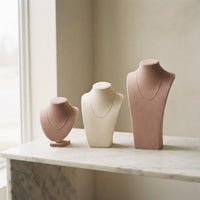
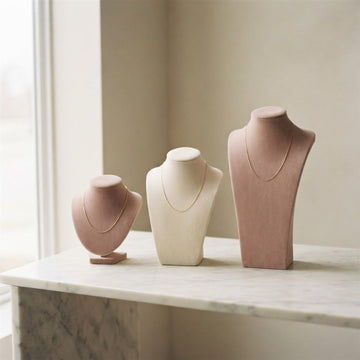
The length of a necklace is measured with the clasp closed and the chain laid flat. On a bust, the necklace falls approximately halfway down from the base of the neck; therefore, choose a necklace bust with a height above the neck that exceeds half the length of the necklace so that the pendant does not touch the base.
| Necklace type | Length | Where it falls | Recommended support |
|---|---|---|---|
| Choker | 35 to 40 cm | At the base of the neck | Small bust, velvet neck, T-shaped support |
| Princess | 42 to 48 cm | On the collarbone | Bust 25 to 30 cm high |
| Matinee | 50 to 60 cm | Above the chest | Bust 30 to 35 cm high |
| Opera | 70 to 90 cm | On the chest | Large bust or wall-mounted hook panel |
| Sautoir | Over 90 cm | Below the chest | Wall-mounted necklace holder, tall jewelry tree |
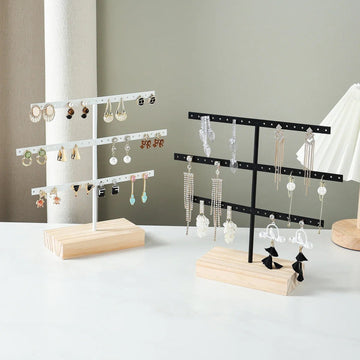
For fine chains laid flat, a jewelry tray with long compartments prevents tangling. Discover all the supports in the necklace display collection and the jewelry busts.
Wrist circumference and bracelet size
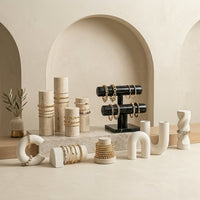
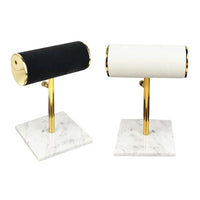
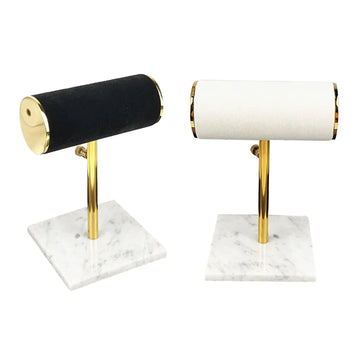
Measure the circumference of your wrist just above the bone with a flexible tape measure, then add 1 cm for a fitted bracelet, 2 cm for a comfortable bracelet, and 3 cm for a loose bracelet. On a bracelet display, the bar or cushion should have a circumference close to your wrist circumference so that the bracelet stays in place without slipping.
| Size | Wrist circumference | Recommended bracelet length |
|---|---|---|
| XS | 13 to 14 cm | 15 to 16 cm |
| S | 15 to 16 cm | 17 to 18 cm |
| M | 17 to 18 cm | 19 to 20 cm |
| L | 19 to 20 cm | 21 to 22 cm |
| XL | 21 cm and larger | 23 cm and larger |
Rigid bangles are best stored on a horizontal bar or cone; flexible bracelets on an oval cushion. See the bracelet display collection.
Ring size: finger circumference and diameter
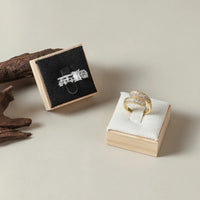
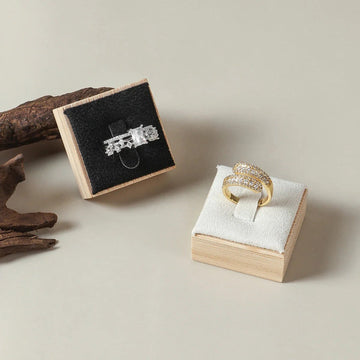
In France, a ring size corresponds to the inner finger circumference in millimeters: a size 54 ring has an inner circumference of 54 mm. The inner diameter is obtained by dividing this circumference by 3.14. These measurements are also useful for choosing a ring display: a post or cone must accommodate the sizes you are displaying, and a slotted strip must be flexible enough to hold thick bands.
| French size | Finger circumference | Inner diameter |
|---|---|---|
| 48 | 48 mm | 15.3 mm |
| 50 | 50 mm | 15.9 mm |
| 52 | 52 mm | 16.6 mm |
| 54 | 54 mm | 17.2 mm |
| 56 | 56 mm | 17.8 mm |
| 58 | 58 mm | 18.5 mm |
| 60 | 60 mm | 19.1 mm |
| 62 | 62 mm | 19.7 mm |
| 64 | 64 mm | 20.4 mm |
For a display case, a slotted tray holds one ring per row; for a dressing table, a cone or ring hand is sufficient. See the ring display collection.
Watches: case diameter, cushions, and slots
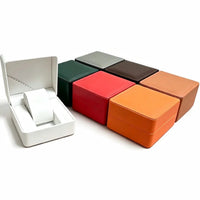
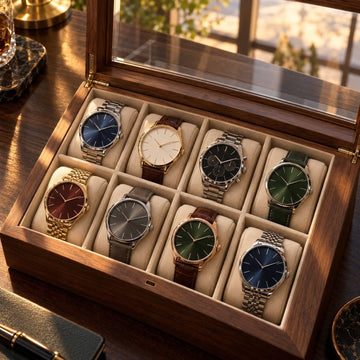
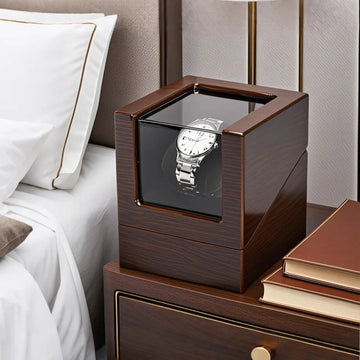
A watch diameter is measured from one side of the case to the other, excluding the crown. Before choosing a watch box, case, or winder, compare the diameter and thickness of your largest watch with the compartment width and height below the lid indicated on the product page.
| Case | Diameter | Check on the product page |
|---|---|---|
| Small | Up to 36 mm | Cushion thin enough for a small wrist |
| Medium | 37 to 42 mm | Compartment width; most boxes will fit |
| Large | 43 to 46 mm | Compartment width and height below the glass lid |
| Extra large | Over 46 mm | Maximum accepted diameter, often specified for winders |
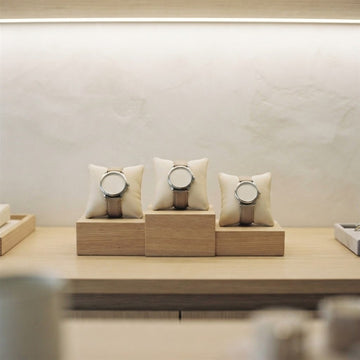
The cushion should fit the closed bracelet: a cushion that is too thick will strain short metal bracelets, while one that is too thin will allow the watch to spin. For a growing collection, allow for a few extra empty slots. See the watch boxes, watch cases, and automatic watch winders.
Jewelry boxes and cases: slots and dimensions
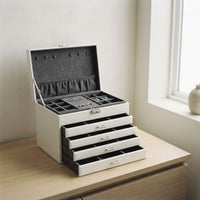
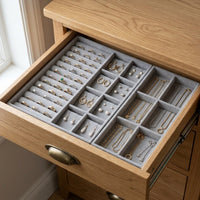
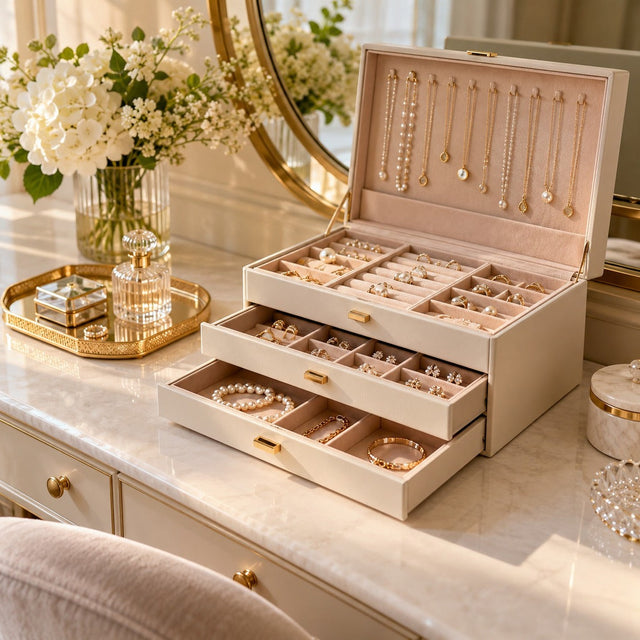
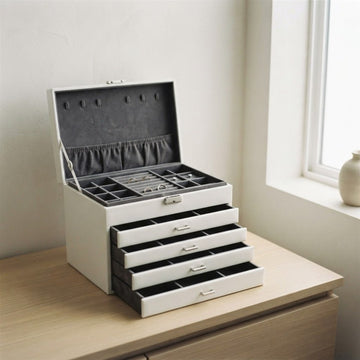
To choose a jewelry box, count your pieces by category, then compare them with the layout described on the product page: the number of ring slots, compartments, necklace hooks, and the exterior dimensions for the intended location (drawer, dresser, suitcase).
| Format | Approximate exterior size | For whom |
|---|---|---|
| Travel box | Approximately 10 to 18 cm | A few rings, a pair of earrings, a chain |
| Single-tier box | Approximately 20 to 25 cm wide | An everyday collection |
| Two- or three-tier box | Approximately 23 to 30 cm wide | Rings, earrings, necklaces, and watches together |
| Drawer tray | Measure the inside of the drawer | Stackable or side-by-side trays |
The exact dimensions of each model are listed on its product page. See the jewelry boxes, travel jewelry boxes, and drawer storage.
Our tips for measuring correctly
- Measure your largest piece: the longest necklace, the largest watch, the widest ring.
- Measure the space: counter depth, height below the shelf, inside the drawer.
- Compare it with the product page: each product lists its dimensions and layout; if in doubt, write to us before ordering.
Unsure about a dimension?
Send us your measurements and the product you are interested in: we will respond within 48 business hours.
Contact usBuying guide