
























How to choose the right jewelry display for your shop window
How to choose the right jewelry display for your shop window
Choosing the right jewelry display is crucial to transforming a simple shop window into a real sales tool. A perfectly showcased piece of jewelry catches the eye, tells a story, and triggers the desire to buy. Conversely, a cluttered or unsuitable presentation devalues even the most beautiful pieces.
In this comprehensive guide, discover all the criteria for selecting the ideal support according to your jewelry, your brand, and your budget.

Why is the choice of display so important?
The display is not just an accessory: it is an extension of your brand image. It guides the customer's gaze, structures the space, and prioritizes your collections. A good support fulfills three essential functions:
- Highlighting: enhancing the color, shine, and details of each piece of jewelry.
- Organizing: arranging the pieces by type, price range, or theme.
- Protecting: limiting handling, scratches, and dust.
Before buying, ask yourself a simple question: what jewelry will I display, and what emotion do I want to evoke?
Adapting the display to the type of jewelry
Each family of jewelry has its own dedicated supports. Choosing a display designed for a specific type of piece immediately improves the readability of your shop window.
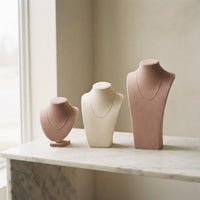
- Necklaces and pendants: opt for busts, vertical necklace holders, or angled displays that prevent tangling and highlight the drape of the chain.
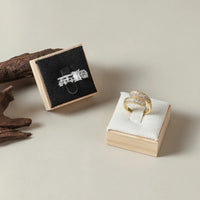
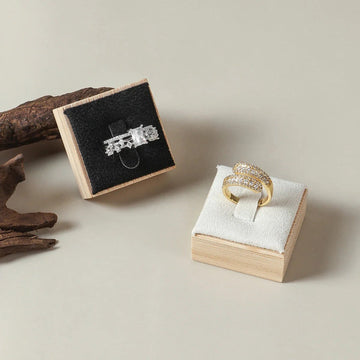
- Rings: choose cones, slotted bars, or cushions, which present the pieces at eye level.
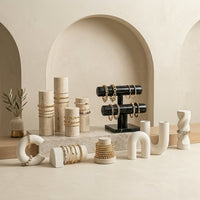
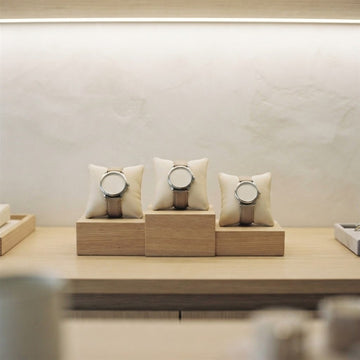
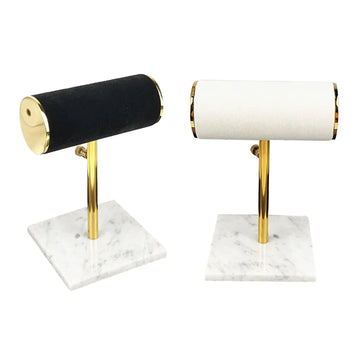
- Bracelets and watches: T-bars, rolls, and cushions fit the shape of the wrist and add volume.
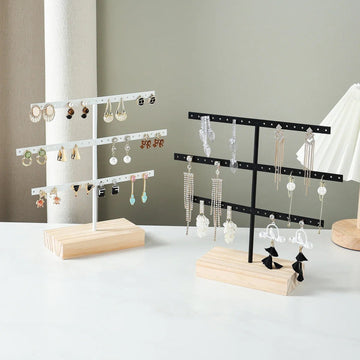
- Earrings: grid or hole displays, or mannequins, allow you to present pairs neatly aligned.
| Type of jewelry | Recommended support |
|---|---|
| Necklaces and pendants | Bust, vertical necklace holder, angled display |
| Rings | Cone, slotted bar, cushion |
| Bracelets and watches | T-bar, roll, cushion |
| Earrings | Grid, hole display, mannequin |
How to prioritize necklaces, rings, and bracelets?
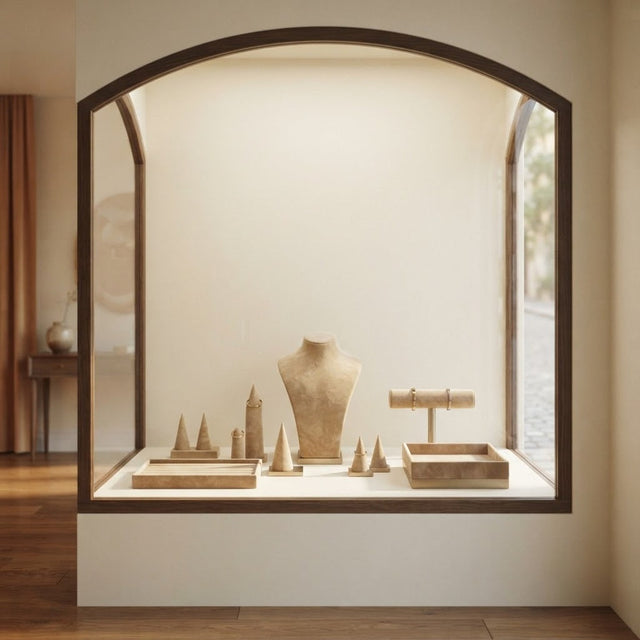
In a shop window, necklaces on busts take up the most height: they serve as a visual anchor. Rings on cones are placed around them, at eye level, and bracelets on rolls or cushions fill the bottom.
This hierarchy prevents the different families of jewelry from competing with each other. Each keeps its zone, and the customer can understand at a glance how the shop window is organized.
Choosing the right material for the display
The material determines the atmosphere of your shop window. It must be in harmony with the style of your jewelry.
- Velvet: timeless and warm, it absorbs light and brings out the shine of metals and stones. Ideal for a high-end image.
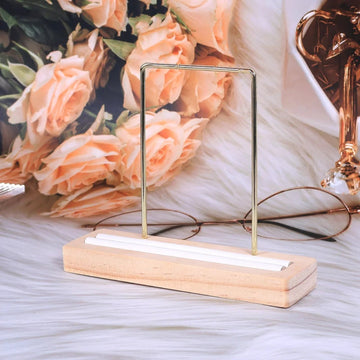
- Wood: natural and trendy, perfect for an authentic, artisanal, or eco-friendly brand.
- Clear acrylic: discreet and modern, it recedes to highlight the jewelry and is suitable for minimalist presentations.
- Marble and metal: luxurious and contemporary, they create a highly photogenic premium effect.
For a cohesive shop window, stick to two complementary materials and a controlled color palette.

Which material to choose according to the shop window lighting?
The material reacts to the lighting, and this detail changes the final result. Before buying, think about how it receives the light from your shop window.
- Velvet absorbs light: stones and metals stand out.
- Clear acrylic lets it pass through: the support disappears.
- Marble and metal reflect it: they create a premium effect, but require well-placed spotlights.
- Wood softens it: it warms up the atmosphere of a bright shop window.
Considering height, volume, and depth
A shop window that sells plays with levels. Alternating heights creates rhythm and naturally guides the eye from top to bottom.
- Place key pieces at eye level.
- Use tiered displays or podiums to arrange the collections.
- Leave empty spaces: "empty space" lets the jewelry breathe and avoids a cluttered look.
The golden rule: fewer pieces, better presented, sell more than a cluttered shop window.
How to arrange the levels in a shop window?
Think in three levels: a lower level for complementary pieces, a middle level at eye level for key pieces, and a higher level for atmosphere and large pieces like necklaces on busts.
Do not fill each level to the brim. A half-empty level allows the eye to move and highlights what is on display.
Not neglecting the lighting
The most beautiful display loses all its appeal without suitable lighting. Light reveals the sparkle of stones and the shine of metals.
- Prefer neutral white to slightly warm light for gold, and cooler light for silver.
- Avoid harsh shadows by using multiple light sources.
- Consider displays with built-in LED lighting for exceptional pieces.

Where to place the light sources?
Place the spotlights high up, slightly in front of the pieces, and point them toward the center of the support. Light coming from the side creates depth on the stones and avoids harsh shadows.
How to limit reflections on the glass?
Angle the spotlights slightly so that their reflection does not fall in the line of sight of passersby. Look at the shop window from the street or from the store aisle: that is what the customer sees, not what the shopkeeper sees.
Consistency, modularity, and budget
Invest in a range of coordinated displays rather than in mismatched pieces. Modularity will allow you to regularly refresh your shop window without buying everything again. As for the budget, think long-term: a quality support enhances your jewelry season after season and pays for itself quickly.
What jewelry display for your shop window according to the size of the space?
The right support first depends on the volume you have available. A jewelry display for your shop window is chosen based on depth, height, and the number of pieces to show, even before the material or color.
Small shop window: focus on verticality
When floor space is limited, you gain space vertically. A bust, a T-shaped support, or a small tiered display takes up little space and gives a real rhythm to the presentation.
- Choose fewer supports, but at different heights.
- Prefer slim shapes that let light pass through.
- Keep an empty area so the eye can breathe.
Large shop window: create reading zones
A large volume is divided into zones: one for necklaces, one for rings, one for bracelets and watches. Each zone has its own dedicated support, and the whole maintains the same material to remain cohesive.
Countertop display or wall display: what are the differences?
A countertop display is viewed from above: angled trays and cushions highlight the pieces. A wall display is viewed from the front: busts, necklace holders, and earring grids work vertically.
What depth and circulation space to allow?
Always leave a few centimeters between the back of the shop window and the first support, and between two supports. This gap makes cleaning, handling the pieces, and the circulation of light easier.
Arranging your shop window step by step
A shop window that sells is prepared like a small staging. Here is a simple method that can be repeated with every change of collection or season.
- Decide on the message: a collection, a style, an occasion.
- Choose the key piece and its support.
- Add the associated pieces on each side.
- Complete with a few supporting pieces at the bottom.
- Step back, look, then remove one element.
Defining the message of the shop window
A shop window that tells a single story is understood in two seconds. Mixing three styles or three dominant colors blurs the message and tires the passerby's eye.
Placing the key piece
The key piece catches the eye and makes people want to enter. Install it at eye level, on the most elaborate support, with space around it.
Balancing and repeating
A triangular composition works almost everywhere: a top, two sides, a base. Repeat a shape or a color two or three times in the shop window to create a common thread.
Adapting your shop window to the style of the store
The same support will not have the same effect in a minimalist store and in an artisanal workshop. The shop window extends the identity of the place: it must adopt its codes.
| Store style | Materials to favor | Desired atmosphere |
|---|---|---|
| Contemporary | Acrylic, metal | Minimalist, modern |
| Artisanal | Wood, linen | Warm, authentic |
| High-end | Velvet, marble | Luxurious, timeless |
A contemporary store: transparency and thin lines
Acrylic and metal recede before the jewelry and let light circulate. They are suitable for bright shop windows, very open to the street.
An artisanal store: wood and natural materials
Wood and linen tell a story of craftsmanship. Keep simple shapes so that authenticity remains visible and does not turn into a cluttered decor.
A high-end store: velvet and marble
These materials create a premium effect. They require careful lighting and very few pieces per shop window to maintain their elegance.
The mistakes that turn customers away from the shop window
Before buying more equipment, look at your shop window with the eye of a passerby: that is the best way to spot what is wrong. Most disappointing shop windows have the same flaws. Spotting them allows you to correct them without changing all the equipment.
Too many pieces in the same place
A cluttered shop window gives the impression of stock, not a selection. The customer no longer knows where to look and keeps walking.
Supports that compete with each other
When each display has its own material, color, and shape, none dominates. Two complementary materials and a controlled palette are enough to keep a shop window readable.

A neglected display case background
The background takes up a third of what the passerby sees. A wrinkled, stained, or overly cluttered background draws the eye away from the jewelry: opt for a plain, matte, and clean background in a shade that complements your supports.
Accessories that take up all the space
Dried flowers, cardboard, ribbons: the decor accompanies the jewelry, it does not replace it. If an accessory draws more attention than the star piece, remove it.
Lighting that creates reflections
A poorly aimed spotlight reflects on the glass and hides the jewelry. Use multiple soft light sources rather than a single harsh light, and check the display case from the outside.
| Mistake | Effect on the customer | Correction |
|---|---|---|
| Too many pieces | Lost gaze | Remove a third of the pieces |
| Disparate supports | Unreadable display case | Two materials, one palette |
| Reflections on the glass | Hidden jewelry | Soft light, multiple points |
| Drowned star piece | No focal point | Eye level, space around |
Maintaining and refreshing your display case
A beautiful display case is never finished. It is cleaned, readjusted, and refreshed regularly to remain desirable.
Regular cleaning of the supports
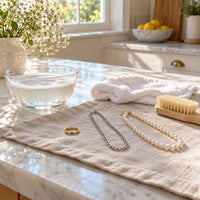
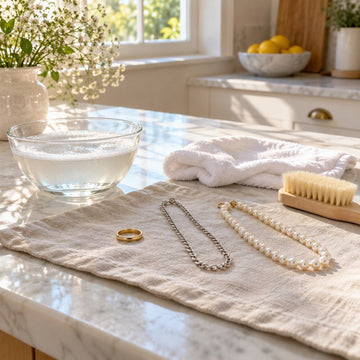
Each material has its own care. Velvet is dusted with a soft brush, acrylic is wiped with a soft non-abrasive cloth, and wood is cleaned with a dry cloth. For more, read our guide on cleaning your jewelry displays.
Refreshing the display case every season
Changing the staging gives customers a reason to stop, even those who already know the store. Keep the same basic supports and vary the pieces, accessories, and accent colors. Our merchandising tips detail other levers.
Should you plan for replacement supports?
Yes, having a few extra pieces makes seasonal changes easier: a damaged support can be replaced without breaking the balance of the display case. This explains the benefit of a coordinated and modular range.

Our favorites for equipping a display case
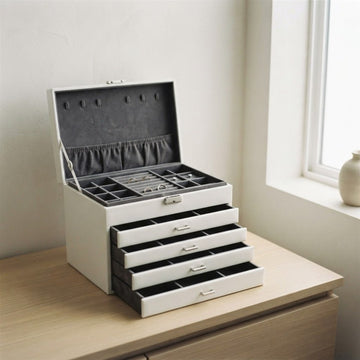
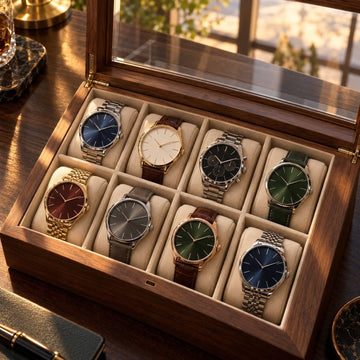
To create a cohesive display case, browse our jewelry holders, our jewelry busts, and our jewelry trays. Here are four models designed for display cases.
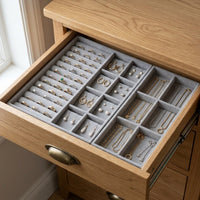
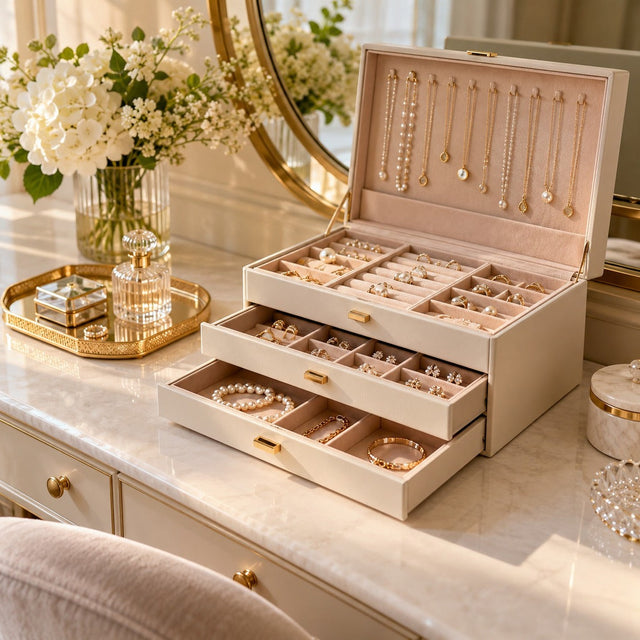
 Beige velvet jewelry display for counter
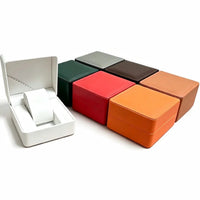
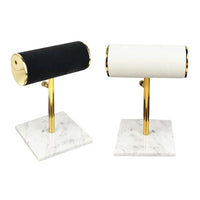
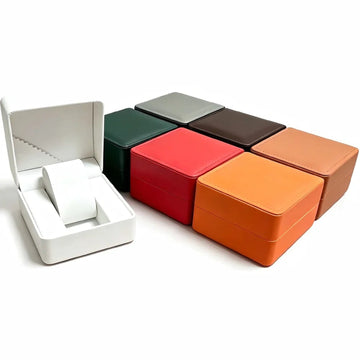
 White square jewelry display for store window
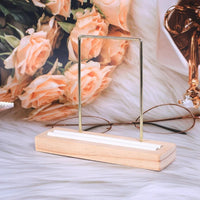
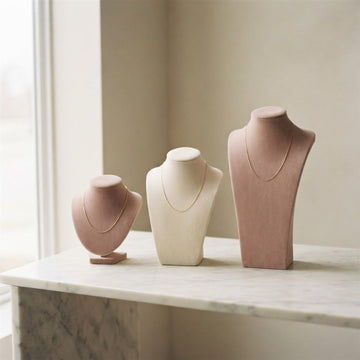
 Velvet and metal bust set
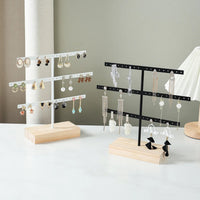
 Black velvet jewelry display for store window
Conclusion
Choosing the right jewelry display means finding the balance between the type of piece, the material, the height, and the lighting, all in the service of a cohesive and desirable display case. Take the time to define your universe, then create a staging that reflects you.

To equip yourself, discover our entire range of supports in our jewelry display collection and create today a display case that catches the eye and triggers a purchase.
Frequently asked questions about jewelry displays for display cases
Which jewelry display should you choose for a small display case?
Opt for thin and tall supports: busts, T-shaped supports, small tiered displays. They free up surface area and let the arrangement breathe.
How many pieces can you display in a display case?
There is no universal number: the rule is to leave enough empty space so that each piece can be seen on its own. Remove one element whenever you hesitate.
Which material should you choose for a display case support?
Velvet provides a high-end look, wood a natural feel, acrylic a discreet and modern effect. Stick to two complementary materials.
How to light a jewelry display case?
Prefer neutral white or slightly warm light for gold, cooler for silver. Use multiple light sources to avoid harsh shadows and reflections.
How often should you change your display case?
A refresh every season or with each new collection is enough. Keep the basic supports and change the pieces and accessories.
What height should you choose for the star piece of a display case?
At the customer's eye level. This is the area where the gaze naturally rests: place the most desirable piece there, with space around it.
How to keep a display case cohesive when you change pieces often?
Invest in a coordinated and modular range of displays. You refresh the jewelry and accessories without buying everything again, and the display case retains its identity.
How to know if my display case is too cluttered?
Step back a few paces: if your gaze does not find the star piece in one or two seconds, there are too many elements. Remove one, then repeat the test.
Do you need different displays for each type of jewelry?
Yes, each family has its dedicated supports: busts for necklaces, cones for rings, rolls for bracelets, grids for earrings.
Get our next articles
Tips, guides and new arrivals, straight to your inbox.