


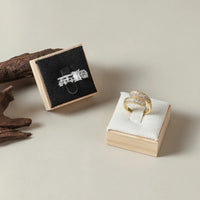




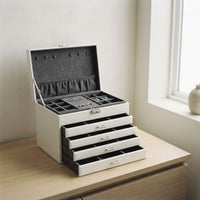


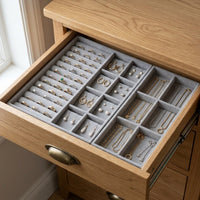


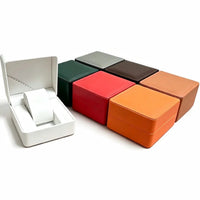



















How to clean and maintain your jewelry displays?
Why clean and maintain your jewelry displays
A jewelry display that loses its luster makes your entire shop window look dull. Dust embedded in velvet, fingerprints on faux leather, subtle oxidation on metal supports: these small everyday flaws eventually devalue even the most beautiful pieces.
Whether you are a jewelry designer, a shop owner, an exhibitor at a craft market, or simply an enthusiast, knowing how to clean and maintain your jewelry displays is essential to preserve their appearance and the perceived value of your collection.

Why regularly maintain your jewelry displays?


A display is more than just a functional accessory: it is the setting that showcases your rings, necklaces, bracelets, and earrings. A dirty, tarnished, or dusty support immediately sends a negative signal to the customer.
Regular maintenance also helps considerably extend the life of your supports. Velvet brushed every week retains its depth of color for years.
Essential maintenance equipment
- Lint-free microfiber cloths
- Soft brush with natural bristles
- Lint roller for velvet
- Vacuum cleaner with a low-power brush attachment
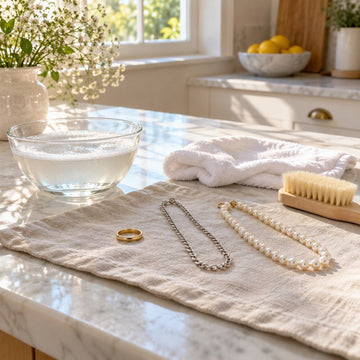
- Distilled water and neutral soap, such as Marseille soap
- Cotton swabs for tight spaces
- White cotton gloves to handle without leaving marks
- Compressed air in a can to dust inaccessible areas
Avoid any standard household products: scented multi-purpose cleaners, pure vinegar, household alcohol, and harsh detergents.
Cleaning a velvet display
Velvet remains the premier material for jewelry supports. It is also the most delicate to maintain.
Daily maintenance
Run a lint roller in the direction of the nap to remove dust and fibers. For heavily used displays, follow up with a low-power vacuum.
Deep cleaning
If there is a stain, never soak the velvet. Very lightly dampen a microfiber cloth with warm water and a drop of neutral soap, then blot without rubbing.
Reviving faded velvet
If your velvet has lost its depth, gently pass over it with a microfiber cloth lightly misted with distilled water, then brush. You can also use a little steam (an iron set to steam, held 15 cm away without touching the fabric).
Refresh your shop window with impeccable displays
Discover our selection of high-end jewelry displays.
View the collection
Maintaining a faux leather display
Faux leather appeals with its chic appearance, durability, and ease of maintenance.
Routine cleaning
A simple, slightly damp microfiber cloth is usually sufficient.
Stubborn stains
For a greasy fingerprint, add a drop of mild soap to the water. Blot, rinse with a cloth dampened with clean water, then dry immediately.
Conditioning and shine
Once a quarter, apply a specific faux leather conditioner. Avoid shoe polish and vegetable oil.
Caring for wooden displays
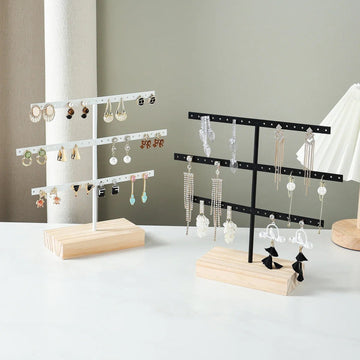
- Oiled wood: soft cloth, apply oil once or twice a year.
- Waxed wood: wipe with a wool cloth, apply mild wax every 3 to 6 months.
- Varnished wood: slightly damp microfiber cloth, dry immediately.
- Raw wood: gentle brushing, never direct water.
Avoid direct sunlight and prolonged exposure to moisture.

Acrylic and glass: perfect transparency
Use a microfiber cloth and a specific glass or acrylic cleaner. For plexiglass, never use alcohol, acetone, or ammonia-based products: they create micro-cracks known as "crazing".
| Material | Dusting frequency | Deep cleaning | Recommended product |
|---|---|---|---|
| Velvet | Weekly | Monthly | Water + neutral soap, soft brush |
| Faux leather | Weekly | Monthly | Damp microfiber, faux leather milk |
| Wood | Weekly | Quarterly | Oil/wax depending on finish |
| Acrylic | Twice a week | Weekly | Plexi cleaner, microfiber |
| Metal | Weekly | Monthly | Soft cloth, mild polish |
Metal, brass, and gold finishes
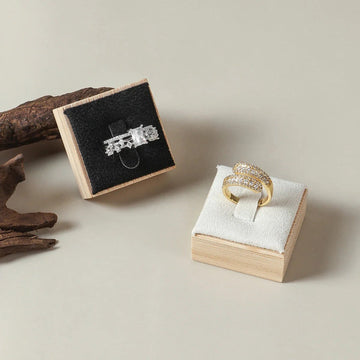
Ring displays in gold-tone metal add a luxurious touch. Dust them every week with a microfiber cloth. In case of light oxidation, use a very mild metal polish.

Recommended maintenance schedule
- Store with daily foot traffic: dusting every morning, weekly deep cleaning.
- Markets and trade shows: full cleaning before every event, brushing the velvet at the end of the day.
- Workshop or personal use: weekly maintenance, seasonal deep cleaning.
Mistakes to absolutely avoid
- Spraying a product directly onto the display.
- Rubbing hard on velvet.
- Mixing aggressive homemade household products.
- Storing the supports without covers.
- Prolonged exposure to direct light.
| Product or action | Avoid on |
|---|---|
| Vinegar | Everything except pure glass |
| Alcohol, acetone, ammonia-based products | Acrylic and plexiglass |
| Shoe polish, vegetable oil | Faux leather |
| Direct water | Raw wood |
| Rubbing hard | Velvet |
| Spraying the product onto the support | All materials |
Suedette, microfiber, linen, and cotton: fabrics that are not velvet
Not all textile supports are cared for like velvet. Suedette, microfiber, linen, cotton, or burlap each react differently to water and rubbing. They share one rule: always start dry, and only use water as a last resort.
Dusting fabric without damaging it
A lint roller or soft brush, passed in a single direction, is usually sufficient. On suedette, the brush also lifts the nap and restores a uniform appearance.
On linen and cotton, a light vacuuming with the brush attachment removes dust lodged between the fibers. Keep the power at a minimum: the fabric should never lift.
Removing a stain without leaving a halo
A halo is created when an area is wetted too sparingly: the water pushes the dirt aside, which then settles at the edges. To avoid this, blot from the center outwards with a barely damp cloth, then blend the edges over a few centimeters.
Let it dry flat, in the open air, away from a radiator. Direct heat stiffens certain fibers and can yellow a light-colored fabric.
Should a fabric display be machine washed?
No, unless the cover is removable and its care label allows it. The inner support (cardboard, foam, wood) is sensitive to water: it swells, warps, and does not return to its shape. When in doubt, stick to localized cleaning.

Marble, stone, and ceramic: mineral care
Displays in marble, travertine, slate, or matte ceramic provide a high-end look, but they have their vulnerabilities. These mineral materials scratch, chip, and react poorly to acids.
Dusting and cleaning with water
A slightly damp, well-wrung microfiber cloth is all you need for routine cleaning. Dry immediately with a second clean cloth to prevent limescale marks, which are very visible on dark or polished surfaces.
Why avoid vinegar and lemon on marble?
Marble is made of limestone, and acids damage it: the surface becomes dull and loses its polish, sometimes after the first contact. This applies to vinegar, lemon juice, and descalers. Opt for a highly diluted neutral soap instead.
Protect the stone from impacts and scratches
Stick small felt pads to the base, place the stand without letting it slide, and never store a heavy piece on top of another. Light-colored stone can also be stained: wipe up any drop immediately, especially a drink or greasy product.
Store and protect your displays between uses
A clean display that is poorly stored will become dirty again in a few weeks. Storage is part of maintenance, especially for creators who set up and dismantle a stand at every market or trade show.
Covers, boxes, and tissue paper
Place each stand in a non-woven fabric cover, like the one mentioned above for markets, or wrap it in acid-free tissue paper. Avoid sealed plastic bags: they trap moisture and encourage mold growth.
Stack without crushing
Store the trays flat, from heaviest to lightest, with a protective sheet between each piece. Velvet shows marks under weight: always leave the visible side facing up, with nothing placed on top.
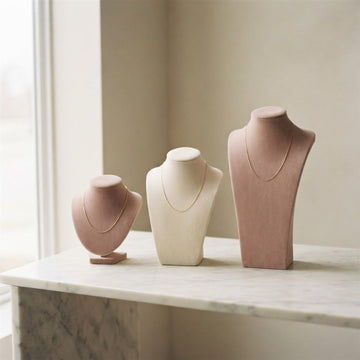
Busts and stem stands should be stored upright or laid flat in a braced case, never under a load.
Where to store: light, humidity, temperature
Choose a dry closet, away from sunlight and heat sources. Prolonged humidity warps wood and tarnishes metals; bright light fades colored fabrics.
In a damp room, a moisture-absorbing packet placed in the box helps keep everything in good condition. For the jewelry itself, see our guide which product to use to clean your jewelry.

Maintenance steps in the correct order
Regardless of the material, the order of steps matters as much as the products. Starting with water before dusting turns dust into mud; finishing without drying leaves marks.
- Dust dry: soft brush, adhesive roller, or compressed air.
- Clean locally: barely damp cloth, one drop of neutral soap at most.
- Rinse with a cloth: a second cloth dampened with clean water removes the soap.
- Dry immediately: dry cloth, then air dry.
- Check: look at the stand under the display case light.
Why always start dry?
Dust mixed with water forms a paste that gets embedded in the fabric grain and wood grooves. When dry, it can be removed completely, and you save moisture for real stains.
How long should you allow for a complete display case?
Allow a few minutes per stand for routine maintenance, and more for a deep clean. Organize by material family: all velvet first, then faux leather, then smooth surfaces, so you don't have to change products for each piece.
How to check the result?
Position yourself at a customer's eye level, with the lights on. A clean stand shows no fingerprints, no flattened velvet pile, and no halo marks. Touch up anything visible immediately: this is the detail the customer notices first.
Prepare your displays before a market or trade show
A stand is judged in a few seconds. The day before a market or trade show, a few steps are enough to present impeccable stands, even after several outings.
The day-before checklist
- Remove each stand from its cover and dust it dry.
- Run the adhesive roller over all velvet, in the direction of the pile.
- Wipe acrylic and glass with a microfiber cloth.
- Check the stability of the stems, bases, and busts.
- Fold the covers into the carrying bag.
What to put in your pocket kit?
A small adhesive roller, a clean microfiber cloth, a pair of white cotton gloves, and a few cotton swabs fit in a pouch. They allow you to touch up a stand in two minutes if a visitor has handled it.
What to do after the event?
Once home, dust before storing, then let the stands breathe for a few hours outside their covers. Transport may have introduced moisture, and a stand stored damp will quickly show marks.
When to replace a display rather than clean it?
Even careful maintenance has its limits. Some flaws won't go away, and a damaged stand spoils the effect of otherwise impeccable jewelry.
The signs that don't lie
| Sign of wear | Best action |
|---|---|
| Flattened or worn velvet | Brush it; if the pile doesn't stand back up, replace the cover or the piece |
| Peeling or cracking faux leather | The cover cannot be repaired: replace the piece |
| Warped or split wood | Check the humidity of the storage area, then replace |
| Deeply pitted metal | A gentle polish is no longer enough: replace |
| Scratched or yellowed acrylic | Replace, and protect future ones from direct light |
Replace by family, not piece by piece
If one stand shows its age, look at those around it. It is better to replace an entire family (all busts, all trays) than to mix a shiny new one with worn-out older ones: the difference is immediately noticeable.
How to choose a replacement?
Depending on your use, opt for acrylic and plexiglass for transparency, velvet for elegance, or metal for fine lines.
For a necklace, browse the necklace and chain displays; for an entire display case, compare velvet and faux leather in our article velvet or faux leather display.
Our favorite products for a polished display
Four displays from the shop, in leather, wood, velvet, and marble, to replace a damaged stand or equip a new display case.
 Black Leather Jewelry Display Tray for Showcase
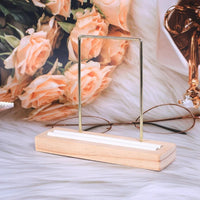
 White Solid Wood Necklace Display for Showcase
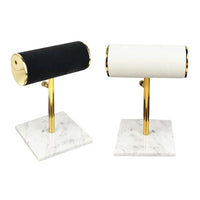
 Black Velvet Jewelry Display for Shop Showcase
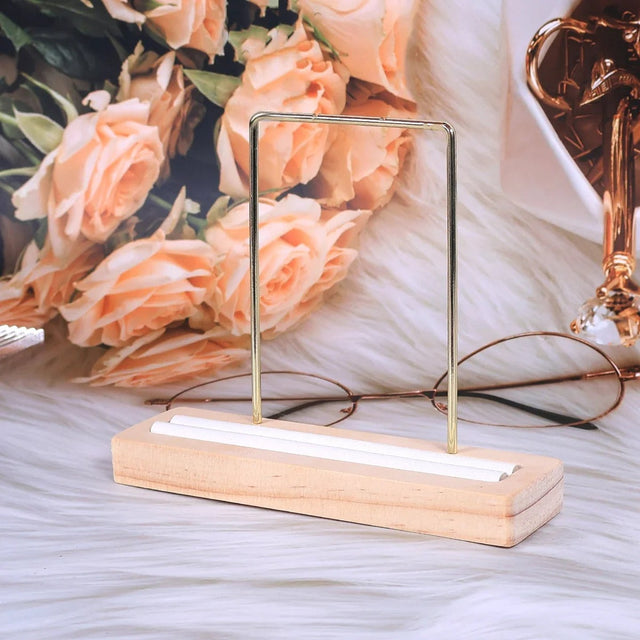
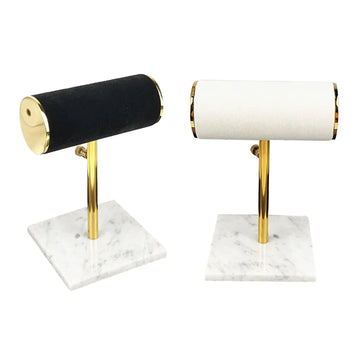
 T-Bar Bracelet Necklace Watch Display in White Marble
Discover the full selection in the jewelry holder collection and the ring displays.
In summary: simple maintenance for a lasting professional effect

A few minutes a week is enough to keep a display case impeccable. A well-maintained display can accompany your shop for 5 to 10 years.
Want to refresh your stock of displays?
Explore our full range of jewelry displays.
Discover the collectionTo go further: Why do jewelry stores use velvet displays? and Wood, metal, velvet or linen display: the material guide.
FAQ
How often should a jewelry display in a shop be cleaned?
A quick dusting every morning and a weekly deep clean is enough in most cases.
Can a velvet display be washed with water?
Not by immersion. It can be dabbed locally with a slightly damp cloth.
How to remove a fingerprint from faux leather?
A microfiber cloth dampened with a drop of neutral soap, using gentle motions, followed by immediate drying.
What product should be used to make a gold display shine?
A gentle brass polish or a special jewelry-impregnated cloth.
Can white vinegar be used to clean a display?
No, except on pure glass. On faux leather, velvet, wood, or metals, vinegar is too acidic.
How to store displays between markets?
In individual non-woven fabric covers, flat or upright depending on the format.
My velvet display smells new, it's annoying. What should I do?
Air it out for 48 hours in a dry room and brush it gently.
Should a new display be cleaned before using it?
A simple dry dusting is enough. If the stand smells new, air it out for a few hours in a dry room before placing it in a display case.
How to clean a marble display?
A slightly damp microfiber cloth with a highly diluted neutral soap, then immediate drying. Avoid vinegar and lemon, which dull the stone.
How to clean an acrylic display without scratching it?
A clean microfiber cloth and a specific plexiglass cleaner, without alcohol or acetone. Wipe without rubbing hard, in one direction.
Get our next articles
Tips, guides and new arrivals, straight to your inbox.