

























Earring storage tip: studs, drop earrings and hoops without the mix-up
Looking for an earring storage tip is often a sign of a drawer where pairs get mixed up, where backs disappear and where drop earrings become tangled. The good news: there are few rules, and they can be summed up in a few simple steps.
This guide brings them together: one row for each type of earring, a fixed place for each pair, and storage suited to the location (wall, drawer, travel). You'll leave with a method, not just a list of products.
Why earrings get lost so quickly
An earring is small, thin and often made of two pieces: the earring and its backing. Stored randomly, it slips into a corner of a box, gets stuck under a compartment or gets mixed up with ten others. The problem comes from storage, rarely from distraction.

The three traps of loose storage
- Tangles: chains and thin stems catch on each other as soon as they touch.
- Mismatched pairs: an earring slips under the others, and the pair is no longer complete.
- Deformation: a drop earring laid flat under a heavy object becomes bent or scratched.
Why the shape of the earring determines the storage
A stud is pierced, a drop earring is suspended, a hoop is threaded. Each shape therefore calls for a different storage method. A single support for the three types forces compromises, and it is these compromises that create clutter.
Before buying or making anything, count your pairs by type. This little five-minute inventory tells you which support you really need.
Take inventory before storing
Spread all your pairs out on a table, then form three piles: studs, drop earrings, hoops. Then set aside those you no longer wear, damaged or orphaned. An earring without its twin is not stored: it is kept separately, in a small box, in case the other reappears.
- A pile to store: the pairs you wear regularly.
- A pile to repair or clean: faulty clasp, tarnished stone.
- A pile of orphans: a single earring, to keep in a small pouch.
Earring storage tip: the four rules that change everything
Four rules are enough to store any collection, from ten pairs to over a hundred. They apply to a drawer as well as a wall display.
- Separate by type: studs on one side, drop earrings on the other, hoops separately.
- Keep the pair together: the two earrings are stored side by side, at the same level.
- See without rummaging: a stored pair should be identifiable at a glance, without moving anything.
- Leave space: two pairs that touch will eventually tangle or scratch each other.
Why a fixed place changes your daily routine
When each pair has its place, you put it back without thinking. Storage no longer requires effort: it takes three seconds, by removing the earrings in the evening. It is this regularity that prevents clutter from returning, much more than a major exceptional sort.
How many pairs per row?
Count about five to seven pairs of studs per row the width of a hand, and three or four drop earrings per row, depending on their width. Beyond that, the pairs touch and the storage loses its purpose.
If your collection exceeds these numbers, add a row or a second support rather than squeezing the pairs. An airy row empties and fills in a few seconds, and it remains pleasant to look at.
These rules also apply to cases. A box with narrow compartments is suitable for studs, but it quickly damages long drop earrings: see our guide for properly storing and protecting your pieces.
Storing studs and backings without losing a backing
Studs, also called backings, are the easiest to lose: small, light, and equipped with a rolling backing. The golden rule is never to store them without their backing.

Perforated plate or slit foam: the duo that works
A perforated plate keeps the stem straight and leaves the backing in place. Slit foam or a strip of felt does the same job in a drawer. Both show the entire pair, which prevents mismatched pairs.
- Pierce the pair side by side, on the same line.
- Replace the backing immediately, without waiting.
- Leave an empty hole between two pairs to spot them.
A strip of felt, the simplest solution
Without a support, a thick strip of felt or foam, placed at the bottom of a drawer, is enough to start. Pierce the studs into it, two by two. You keep the idea of a row, without buying anything, and you test your way of storing before choosing a model.
The trap of the loose backing
A backing placed loosely in a dish disappears in a few weeks. If you don't have a plate, slide it onto the stem as soon as you remove the earring. A grid or hole support solves this point effortlessly.
Storing drop earrings and hoops without bending them
Drop earrings have an opposite rule: they are suspended, they are not laid flat. An earring that hangs freely keeps its shape and does not get tangled. Hoops, on the other hand, like a bar that follows their curve.

Why hanging rather than laying flat
A suspended drop earring does not suffer any pressure. Its chain remains smooth and its stone does not rub against anything. In addition, you see the entire collection at a single glance, which speeds up the morning choice.
A useful marker: the space between two rows must exceed the length of the longest hung pair. If a pair touches the row below, it rubs every time you remove another one.
Hoops: a round bar, never a pile
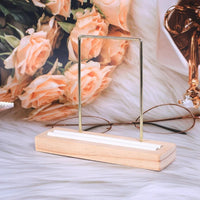
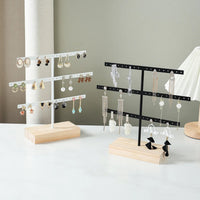
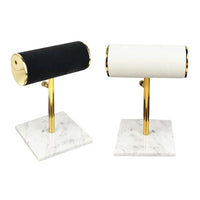
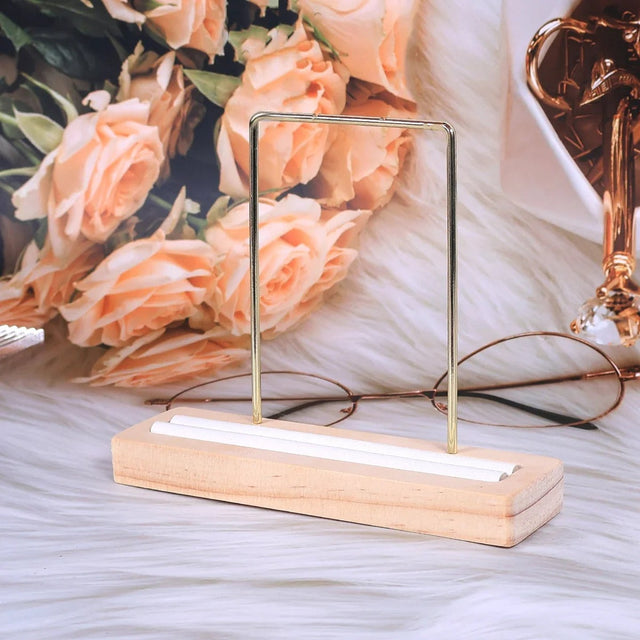
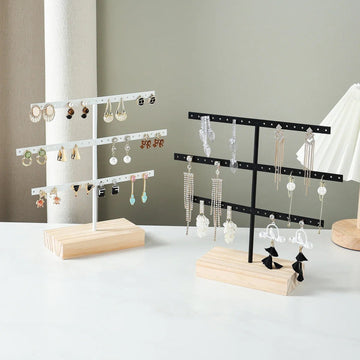
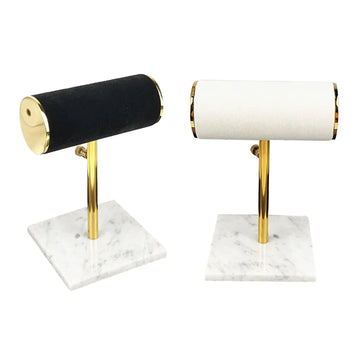
Piled in a box, hoops get stuck between each other. Threaded on a bar or on a row frame, they remain separate. The models below show two ways to do it, in gold or wood.


On the wall, in a drawer or on the dressing table: where to store them?
The right storage depends less on style than on space. A free wall, a dresser drawer or a dressing table: each location has its solution, its strengths and its limit.
| Where to store | For whom | Strength | Limit |
|---|---|---|---|
| On the wall | Little horizontal surface | Frees up the dressing table, everything is visible | Requires proper fixation |
| In a drawer | For those who want to hide everything | Protects from dust | You see the collection less |
| On the dressing table | Daily use | The pairs are within reach | Takes up space |
| In a compact box | Travel or bag | Fits everywhere | Only a few pairs |
No solution is better than another. A large collection often benefits from combining two locations: a wall support for everyday pairs and a drawer tray for special occasions.
On the wall: the grid, the cloud or the star
A mesh grid, hung by a chain, welcomes studs as drop earrings. Some take a decorative shape, cloud or moon and star. They are seen from afar and require a single nail or a single hook.

In a drawer: trays and compartments
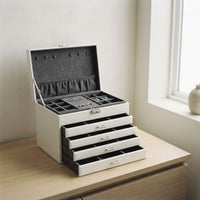
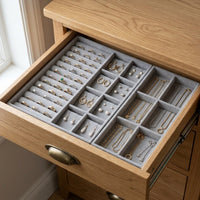
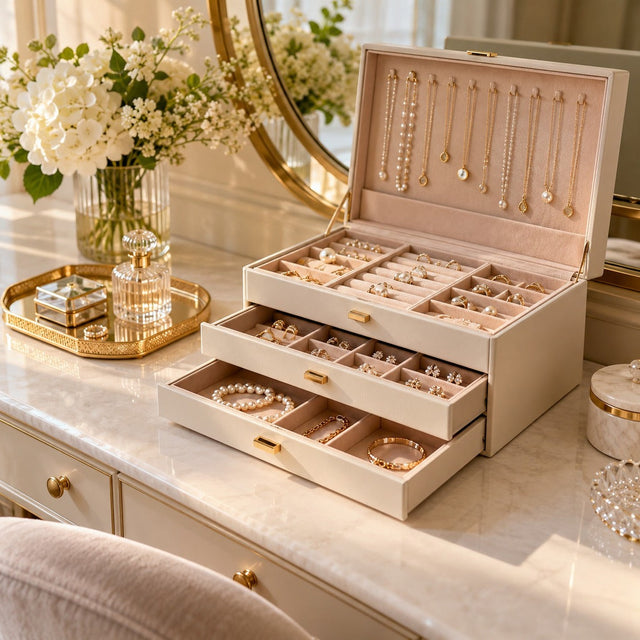
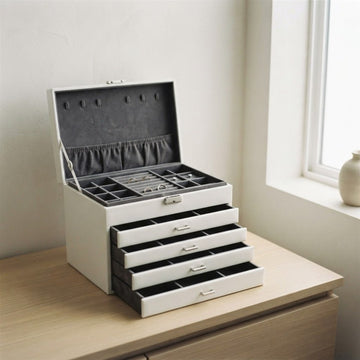
A drawer calls for a low, rigid tray that keeps the pairs flat without mixing them. Choose compartments wide enough for an entire pair. You will find models in our jewelry trays.

Storing your earrings while traveling
When traveling, storage must fit in a bag and protect each pair from impacts. The principle remains the same: separate the pairs, leave nothing rolling.

What to pack in your suitcase
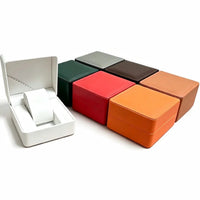
- A closed compartment box for everyday pairs.
- A soft pouch for hoops, which can be slipped in flat.
- Fragile drop earrings in an individual compartment, never loose.
Protecting pairs during the journey
At the bottom of a bag, earrings suffer impacts and friction. An individual compartment, even a simple one, prevents posts from bending and stones from scratching. Always close the box, and avoid placing it under a heavy object.
Limit the selection: three or four pairs that go with all outfits are enough for a weekend. The rest of the collection waits at home, on its stand.

Homemade or ready-made: how to choose?
Making your own storage is possible: a cork board, a frame with a fine mesh, a drilled wooden bar. These solutions are handy and require little effort. Above all, they show you what you need before investing.
| Criterion | Homemade | Commercial stand |
|---|---|---|
| Setup | Takes time and materials | Ready to place or hang |
| Durability | Depends on the chosen material | Designed for the weight of the pairs |
| Appearance | Unique, sometimes irregular | Uniform, well-spaced rows |
| Evolution | Easy to remake or modify | Can be complemented with other models |

When homemade is enough
For fewer than twenty pairs, a simple stand does the job perfectly. You gain space and discover what matters to you: longer rows, wall or drawer, overview or discretion.
When to switch to a ready-made model
As soon as the collection grows, a stand designed for this purpose keeps the rows straight and withstands time better. You can browse the earring displays to compare shapes, from the tiered frame to the wall grid.
Five mistakes that damage earrings
A few habits destroy a good storage system. Here they are, with the reflex that replaces them.

- Mixing everything in a single box: separate at least studs, drop earrings and hoops.
- Storing one earring without the other: the pair always comes back together.
- Stacking drop earrings flat: hang them or give them a wide compartment.
- Forgetting the backs: put them back on the post as soon as you remove the earring.
- Storing damp earrings: wipe them first, especially silver, which tarnishes quickly.
One last reflex helps a lot: once a season, take out all the pairs, look at the clasps and the posts, then put each one back in its place. This ten-minute check spots a bent post or a worn back before they cause a loss.
None of these mistakes is serious in isolation. It is their accumulation that transforms a tidy drawer into an impossible one. Correct one per week: the result is quickly visible, and you keep the habit.

A few models to take action
Here are a few stands seen in this article, to go from idea to practice. The choice depends on your space and your pairs: find them all in the collection of earring displays.
- Row frame on a base: for the dressing table, with one row per earring type.
- Wooden tiers: for a dresser, when you like to see the whole collection.
- Cloud wall grid: to gain space on a free wall.
Metal earring display on wooden baseGold earring displayWooden earring display Gold metal cloud wall jewelry holder

To go further: Homemade earring holder: grid, tulle or drilled board.
Frequently asked questions about earring storage
How to store your earrings without losing them?
Store each pair side by side on a dedicated stand: board or foam for studs, bar or grid for drop earrings. Always put the backs back in place. This three-second habit prevents most losses, much more than an occasional big sort.
How to store your stud earrings?
Stick them in a perforated board, split foam or mesh grid, the pair on the same line and the back on the post. Leave a free hole between two pairs to spot them at a glance and remove them without catching the neighbor.
How to store your earrings in a drawer?
Use a tray with compartments wide enough for a whole pair, and separate studs, drop earrings and hoops. Avoid stacking two trays without emptying them, because the bottom one becomes inaccessible and the pairs are forgotten there. A low and rigid tray remains the most practical.
Where to store your earrings when you lack space?
On the wall: a mesh grid or a row frame frees up the dressing table and shows the whole collection. Remember to fix the stand well, with anchors adapted to the nature of the wall, and to leave space between two rows.
How to prevent drop earrings from tangling?
Hang them on a hook or a bar, with a small space between each pair. Store the longest ones at the bottom of the stand, so nothing rubs when you remove another pair. A drop earring laid flat tangles much faster.
What storage for earrings while traveling?
A compact box with compartments or a soft pouch, with only a few pairs. Each pair in its compartment, box closed, and nothing rolling at the bottom of the bag. Provide a small separate pouch for spare backs.
Your five-minute action plan
To apply this earring storage tip today, follow these steps in order.
| Step | Action |
|---|---|
| 1 | Sort the pairs by type: studs, drop earrings, hoops |
| 2 | Count them to know which stand is missing |
| 3 | Choose the location: wall, drawer or dressing table |
| 4 | Store each pair side by side, back replaced |
To go further, discover the collection of earring displays and our jewelry trays. You can also read our guide on the jewelry tree or on display maintenance.
Frequent searches: earring storage, wall earring storage, drawer earring storage, stud earring storage, drop earring storage, travel earring storage, how to store your earrings, earring display, earring organizer, earring stand, earring storage tray.
Get our next articles
Tips, guides and new arrivals, straight to your inbox.