

































Automatic watch winder: how to choose the right one?
An automatic watch winder keeps your watches moving when you're not wearing them: they stay on time, the date remains correct, and you have nothing to reset. You just need to choose a model suited to your watches, as incorrect settings won't charge anything.
This guide explains what a winder is used for, who really needs one, which criteria to compare (TPD, direction of rotation, motor, capacity, power supply) and how to set it. The values provided are guidelines: your watch manual remains the reference.
What is an automatic watch winder used for?
In an automatic watch, an oscillating mass called a rotor turns with the movements of the wrist and winds the mainspring. Placed on a table, the watch draws on its power reserve, which is around 38 to 50 hours for common movements, and then stops.

What a winder actually does
The winder rotates the watch on its cushion according to a program of rotations and pauses. The rotor continues to charge the mainspring, and the watch stays on time without you having to touch it.
What it does not do
- It does not repair anything: a watch that is running slow needs to be serviced.
- It does not recharge a stopped watch: it maintains an existing reserve.
- It is useless for a quartz watch: the battery does the work.
The power reserve, in a nutshell
The power reserve is the time during which the watch runs without being worn. It varies depending on the movement and is stated in the manual. Beyond that, the watch stops, and you have to reset the time and then reset the date.
This is the chore that the winder eliminates: as long as the watch is running, it remains accurate to the day, ready to be put on in the morning.
To understand the movements that wind a watch by hand, see our guide on how to wind an automatic watch.
Who really needs a winder?
A winder is not a collector's gadget, but it is not useful for everyone. It all depends on the number of automatic watches you alternate and their complications.
| Your situation | Winder useful? | Why |
|---|---|---|
| 2 automatic watches or more to alternate | Yes | Each watch remains ready, without having to reset the time. |
| Day-date, moon phase, annual calendar | Highly recommended | Resetting a stopped complication is time-consuming and sometimes delicate. |
| An automatic watch worn every day | Optional | The wrist is enough; the winder is mainly useful on weekends. |
| Manual-wind watch | No | Without a rotor, rotation does not charge anything. |
| Quartz watch | No | The battery does the work. |

Why complications are affected first
A moon phase or perpetual calendar is reset in several steps. For these watches, avoiding stopping saves a lot of manipulation. Conversely, for a simple date watch, a few seconds are enough to reset the time.
The case of the gifted or valuable watch
A watch you care about deserves storage that protects it as much as it maintains it. A winder with a glass lid keeps it safe from dust, visible, and always on time. For a gift, think first about the person's number of watches: a double or triple model avoids it being too tight from the first year.
Which automatic watch winder to choose: the 5 criteria
Five criteria separate a suitable model from one that will end up at the bottom of a closet. Compare them in this order, from most important to most practical.
1. The TPD, or number of turns per day
The TPD (turns per day) indicates how many rotations the winder makes in 24 hours. It is the most important setting: too low, the watch eventually stops; too high, the barrel's clutch system works for nothing.
Choose therefore a winder that offers several TPD settings, rather than a single fixed program.
2. The direction of rotation
A rotor winds the watch clockwise, counter-clockwise, or both. If the winder turns in the wrong direction, the rotor turns in vain, even with a perfect TPD.
A good model offers all three modes. If in doubt, the bidirectional mode is the safest.

3. The motor: silence and reliability
The motor separates the winder you keep for ten years from the one you unplug after a week. Look for a silent motor, especially for a bedroom, and protected from magnetic fields, so as not to magnetize the watches.
Beware of product sheets that say nothing about noise or the motor: a doubt to clear before purchase.
4. The number of slots
Count your automatic watches, not your entire collection. Only those you keep ready need a rotating slot.
- 1 slot: a release watch or a piece with a complication.
- 2 to 3 slots: the most common format, to alternate during the week.
- 4+6 format: four rotating modules, six fixed slots for watches at rest.
- 6 slots and more: for collectors, often in the form of a chest.

5. The power supply and programs
Most winders operate in cycles: a series of rotations in one direction, a pause, then a series in the other direction. This rhythm imitates the wrist, which turns then rests.
Mains power remains the most consistent solution for a winder that does not move. Battery-powered or dual-powered models make up for travel or being far from an outlet, but require regular replacement.
Regarding programs, check that the winder alternates rotations and pauses: it is closer to wearing on the wrist, and gentler for the movement. For any question about electrical power, follow the manual and call a professional at the slightest doubt.
Reading a product sheet without making a mistake
Before buying, look for this information on the sheet. If one is missing, ask the question before ordering.
- Adjustable TPD: several programs, not just one.
- Direction of rotation: clockwise, counter-clockwise, and bidirectional.
- Pause program or night mode, useful in the bedroom.
- Power supply: mains, batteries, or both.
- Cushion size: it must accommodate your wrist circumference and your case.
Which material and format to choose?
The material does not change the winding. However, it decides where the winder will find its place, and if it will stay there.
| Material | Style | Ideal for | Point of attention |
|---|---|---|---|
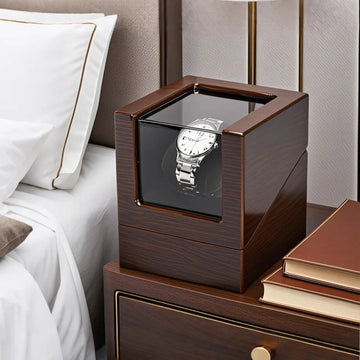
| Wood | Classic, warm | Desk, living room, gift | A glossy finish shows fingerprints |
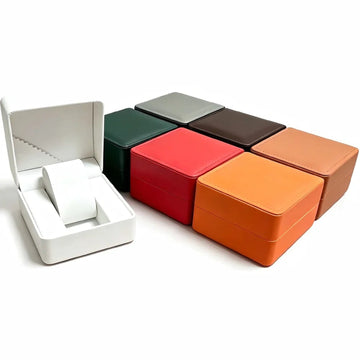
| Leather or faux leather | Sober, masculine | Dressing room, bedroom | Check for even stitching and a soft interior |
| Glass and metal | Contemporary | Displaying a statement piece | Watch visible at all times |
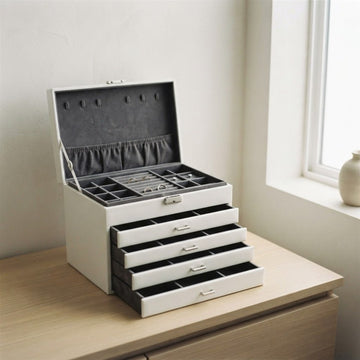
| Winder chest | Large capacity | Large collection | Bulkiness and weight to consider |
Why complications are affected first
A moon phase or perpetual calendar is reset in several steps. For these watches, avoiding stopping saves a lot of manipulation. Conversely, for a simple date watch, a few seconds are enough to reset the time.
The case of the gifted or valuable watch
A watch you care about deserves storage that protects it as much as it maintains it. A winder with a glass lid keeps it safe from dust, visible, and always on time. For a gift, think first about the person's number of watches: a double or triple model avoids it being too tight from the first year.
Which automatic watch winder to choose: the 5 criteria
Five criteria separate a suitable model from one that will end up at the bottom of a closet. Compare them in this order, from most important to most practical.
1. The TPD, or number of turns per day
The TPD (turns per day) indicates how many rotations the winder makes in 24 hours. It is the most important setting: too low, the watch eventually stops; too high, the barrel's clutch system works for nothing.
Choose therefore a winder that offers several TPD settings, rather than a single fixed program.
2. The direction of rotation
A rotor winds the watch clockwise, counter-clockwise, or both. If the winder turns in the wrong direction, the rotor turns in vain, even with a perfect TPD.
A good model offers all three modes. If in doubt, the bidirectional mode is the safest.
3. The motor: silence and reliability
The motor separates the winder you keep for ten years from the one you unplug after a week. Look for a silent motor, especially for a bedroom, and protected from magnetic fields, so as not to magnetize the watches.
Beware of product sheets that say nothing about noise or the motor: a doubt to clear before purchase.
4. The number of slots
Count your automatic watches, not your entire collection. Only those you keep ready need a rotating slot.
- 1 slot: a release watch or a piece with a complication.
- 2 to 3 slots: the most common format, to alternate during the week.
- 4+6 format: four rotating modules, six fixed slots for watches at rest.
- 6 slots and more: for collectors, often in the form of a chest.
5. The power supply and programs
Most winders operate in cycles: a series of rotations in one direction, a pause, then a series in the other direction. This rhythm imitates the wrist, which turns then rests.
Mains power remains the most consistent solution for a winder that does not move. Battery-powered or dual-powered models make up for travel or being far from an outlet, but require regular replacement.
Regarding programs, check that the winder alternates rotations and pauses: it is closer to wearing on the wrist, and gentler for the movement. For any question about electrical power, follow the manual and call a professional at the slightest doubt.
Reading a product sheet without making a mistake
Before buying, look for this information on the sheet. If one is missing, ask the question before ordering.
- Adjustable TPD: several programs, not just one.
- Direction of rotation: clockwise, counter-clockwise, and bidirectional.
- Pause program or night mode, useful in the bedroom.
- Power supply: mains, batteries, or both.
- Cushion size: it must accommodate your wrist circumference and your case.
Which material and format to choose?
The material does not change the winding. However, it decides where the winder will find its place, and if it will stay there.
| Material | Style | Ideal for | Point of attention |
|---|---|---|---|
| Wood | Classic, warm | Desk, living room, gift | A glossy finish shows fingerprints |
| Leather or faux leather | Sober, masculine | Dressing room, bedroom | Check for even stitching and a soft interior |
| Glass and metal | Contemporary | Displaying a statement piece | Watch visible at all times |
| Winder chest | Large capacity | Large collection | Bulkiness and weight to consider |

A winder alone or a box?
A winder alone sits on a dresser and is easy to move. A box combines winders and fixed storage in a single piece of furniture: practical for a collection, but more bulky. If you only want to store watches when they are not in use, a watch box is enough.

Which material withstands daily use best?
No material is superior to the others: it all depends on use. Wood matches a desk or living room, leather matches a dressing room, glass matches a display case. In a bedroom, a matte finish is preferable, as it shows fewer marks.
Also think about maintenance: a soft, dry cloth is enough for most surfaces, and an aggressive product damages both varnish and leather.
Dimensions to check before buying
Measure the available space on the dresser or shelf, including the height of the open lid. Also check that the cushion accommodates the diameter and thickness of your watch cases: a large diving watch may not fit into all models.
For a mixed collection, a model with removable cushions adapts better to different strap sizes.
For a display case or shop
To display watches rather than maintain them, other supports are better suited: see our article on watch displays, boxes and display cases.
Properly setting your winder in 4 steps
The TPD and rotation direction settings are generally found on the back or under the module. Four steps are enough to get started.
- Wind the watch by hand: twenty to thirty turns of the crown, to start with a full power reserve. The winder maintains it, it does not recharge it.
- Set the direction and TPD according to the watch manual. Otherwise, start in bidirectional mode around 650 TPD.
- Secure the watch tightly on the cushion: the strap must neither slip nor strain the lugs.
- Observe for a week: if the watch stops or runs slow, increase the TPD in increments of about 100 turns.

What to do if the watch still stops?
- The TPD may be too low: increase in increments of about 100 turns.
- The rotation direction may be wrong: try bidirectional mode.
- The watch is slipping on its cushion: tighten the strap.
- The problem persists: have the watch checked by a watchmaker.
How long to leave it running?
A good winder distributes its rotations over 24 hours with rest periods. It can therefore be left plugged in permanently. If you do not plan to wear a watch for months, you can even let it stop.
Errors to avoid with a winder
Five errors occur often. Knowing them prevents returning a winder or, worse, setting a watch incorrectly.
- Choosing a single program: without adjustable TPD or direction, it is impossible to adapt it to a new watch.
- Placing the winder near a speaker or magnet: even protected, avoid magnetic sources.
- Buying too tight: a collection grows quickly, an extra slot costs less than a second winder.
- Putting a manual-wind watch in it: it will not recharge, regardless of the setting.

Why avoid magnets
A magnetic field can disrupt the setting of a mechanical watch: it runs fast, or slow without reason. Keep the winder away from speakers, magnetic closures, and wireless chargers.
Watches not to mix
Store quartz or manual-wind watches in a fixed location or in a case. They have nothing to gain from rotating, and their place is elsewhere than on a rotating module.
Models to get started
Here are a few models to move from reading to action. Find them, and many others, in the automatic watch winders collection and among the watch boxes with winders.
How to read these models
Always compare the sheet of each model with the criteria seen above: adjustable TPD, rotation direction, number of slots, power supply. A photo is not enough to choose.
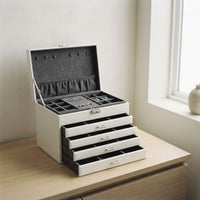
 Wooden automatic watch winder box
 Leather watch winder for desk or bedroomLeather watch box with rotating winders
 Wooden watch box with large capacity winder

From the first winder to the large collection
For one or two watches, a simple or double model is enough and takes little space. For four watches or more, a winder box combines everything in a single piece of furniture. In between, a multi-slot format leaves room without cluttering.
Our guide to watch boxes also helps choose storage for watches that do not need to rotate.
To go further: How many turns to wind an automatic watch? Reliable tips and steps and How long does an automatic watch run without being worn?.
Frequently asked questions about the automatic watch winder
Does a winder damage an automatic watch?
No, if it is properly set: the movement undergoes the equivalent of what it would experience on the wrist. An excessive TPD unnecessarily wears out the barrel clutch, hence the importance of following the watch manual and choosing a model with pauses.
Which TPD to choose for my watch?
Consult the watch manual. Otherwise, 650 TPD in bidirectional mode suits most common movements; increase in increments of about 100 turns if the watch stops.
Should the winder be left on permanently?
Yes, it is designed for it. A good model distributes its rotations over 24 hours with rest periods. For a watch unused for months, you can conversely let it stop.
Does a winder work with a manual-wind watch?
No. Without a rotor, the rotation does not transmit any energy to the spring. These watches are stored in a fixed location or in a case.
Does a watch winder make noise?
It depends on the motor. Check that the sheet mentions silent operation, especially for a bedroom, and favor a pause mode or a night mode.
How long does it take to recharge a stopped watch on a winder?
Several hours, sometimes a day: the winder is not designed for this. Wind the watch by hand first, then let the winder maintain the charge.
Choosing your winder in three questions
To decide without hesitation, answer these questions in order.
| Question | If the answer is… | Aim for |
|---|---|---|
| How many automatic watches? | One or two | A single or double winder |
| How many automatic watches? | Four or more | A winder box |
| Where to place it? | In a bedroom | Silent motor, night mode |
| Which movement? | I do not know | Adjustable TPD, bidirectional |

Remember the essentials: an adjustable TPD, a rotation direction suited to your watches, a silent motor and a number of slots that leaves room. The rest, material and format, is a matter of taste and available space.
When your choice is made, browse the automatic watch winders collection and the watch boxes with winders. A good winder is set once, then forgotten.
Frequent searches: automatic watch winder, which automatic watch winder to choose, best automatic watch winder, silent automatic watch winder, automatic watch winder 2 watches, automatic watch winder 4 watches, automatic watch winder box, automatic watch winder box, wooden automatic watch winder, battery-powered automatic watch winder, affordable automatic watch winder, how an automatic watch winder works.
Get our next articles
Tips, guides and new arrivals, straight to your inbox.