
























The Art of the Shop Window: How to Catch the Eye Before a Customer Even Enters
The art of the shop window comes down to a few principles: a focal point, tiered heights, just right lighting, and a changing display. This article brings them together, with a step-by-step method for creating and maintaining the display window of a jewelry store, counter, or stand.
The importance of a display window that catches the eye
On the street, you have exactly four seconds. Four seconds during which a passerby scans your display window with their eyes, decides in a fraction of a second if it is worth stopping, then continues their way or pushes open the door. This decision is not based on the price or the pieces: it is based on the visual composition.
A well-thought-out display window catches the eye from across the sidewalk, slows down the pace, and sparks curiosity. A poorly calibrated display window, even with the most beautiful pieces in the world, becomes invisible. Understanding the art of the display window means learning to orchestrate lighting, height, color, displays, and rhythm so that they work together.
This guide gives you the principles that the best jewelry stores use to transform every square meter of glass into a commercial magnet — without a Place Vendôme jewelry budget.

The 3-second rule: what a passerby really sees


Before thinking about pieces, backgrounds, and lighting, understand what is going on in the passerby's mind. In three seconds, their eye catches three things, in an almost universal order: the dominant colored mass, the brightest spot, then an identifiable silhouette or object. If these three pieces of information tell a coherent story, they will stop.
Otherwise, they will pass by.
This means that your display window must be readable without reading. There is no need to understand the details: you need to understand the intention. This is the difference between a display window "filled with jewelry" and a display window that tells a story of a season, a collection, or a flagship piece. The first tires the eye, the second seduces.
Creating a focal point that draws the eye
Every effective display window relies on a single focal point. This is the image the passerby will take away. Concretely, it is an area of a few square decimeters where the following converge: the flagship piece, the highest display, the most precise lighting, and often a graphic element (strong color, seasonal accessory, sign).

This focal point should be placed approximately at the left third or the right third of the display window, never exactly in the center. The rule of thirds, applicable in photography, also applies to display windows: a controlled imbalance always draws the eye more than perfect symmetry.
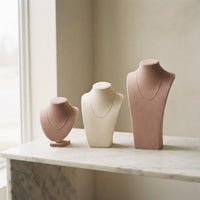
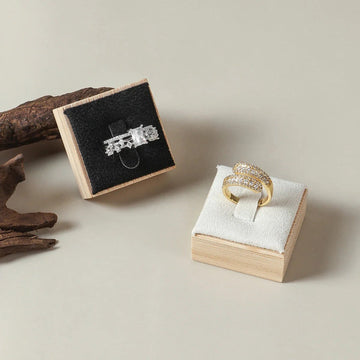
A few examples of effective focal points: a gold necklace presented on a tall necklace bust, topped with a directional spotlight; an engagement ring on a velvet cushion, highlighted in the center of a more sober display window; a mini capsule collection on a tray, framed by two more discreet supports.
The flagship piece can change every month — this is even recommended.
The hierarchy of heights: making the space come alive
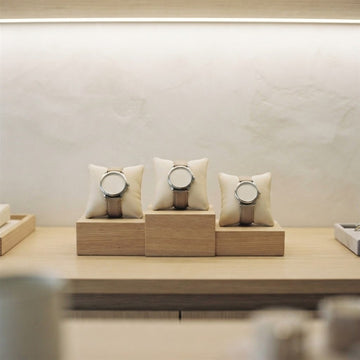
A flat display window at a single height is boring. A display window that plays with three levels creates rhythm. Visualize your space in zones:
- Lower zone (0–25 cm): trays, cases, elongated supports. This is the horizon of the display window.
- Middle zone (25–55 cm): short busts, ring supports, mini totems. This is the level where the eye rests most naturally.
- Upper zone (55–90 cm): large necklace busts, vertical supports, discreet signage. This is the level that catches the eye from afar.
The "1/3 – 1/3 – 1/3" rule does not always work: try "60% lower + middle, 40% upper" for an intimate display window, or "30% lower + middle, 70% upper" for a theatrical display window visible from afar. A large central bust may be enough to transform the entire composition.
Give your display window dimension with our displays
Tall busts, medium supports, trays, and cushions: create a three-level scenography that slows down the passerby.
View all our displaysLighting: your best silent salesperson
Lighting brings jewelry to life like no other material. For a jewelry display window, the winning combination combines ambient lighting, accent lighting, and the interior lighting of the displays.
Ambient lighting
2700 K to 3000 K LED spotlights diffused on the ceiling, with a CRI higher than 90 to respect the colors of the metals. This warm light reassures and makes you want to enter.
Accent lighting
Directional spotlights oriented toward the flagship pieces. Cooler (3500 K to 4000 K), they make the stones and silver sparkle. Avoid 5500 K and above, which makes display windows look like hospitals.
Integrated lighting
Mini LED strips hidden in the displays, under the trays, behind the display windows. They create a soft halo that enhances the cases and jewelry boxes.
Simple adjustment: the interior lighting of the display window must always be more intense than the street lighting. Otherwise, the glass becomes a mirror and the passerby only sees their reflection. This is the #1 mistake of invisible display windows at 6 p.m.
Colors and materials: creating an immediate emotion
A display window is also a palette. The passerby does not read a text: they feel a color. Three families dominate in jewelry.

- Warm tones (camel, terracotta, honey, brick): warm, timeless, ideal for yellow and rose gold, perfect for autumn and the end of the year.
- Cool tones (pearl gray, midnight blue, pine green, taupe): sophisticated, highlight silver, steel, and light stones.
- Deep velvets (burgundy, plum, emerald): luxurious, dramatic, perfect for fine jewelry pieces or seasonal display windows.
Work with controlled contrast: a dark background makes a gold piece pop, a cream background softens a set piece. Jewelry trays in velvet, linen, or faux suede are the simplest tools to change the mood from one month to the next without redoing the entire display window.
The strategic role of displays
The display is not an accessory: it is the infrastructure of your display window. It sets the height, directs the light, and sets the material tone. Here is the role of each family in the display window.
Necklace busts
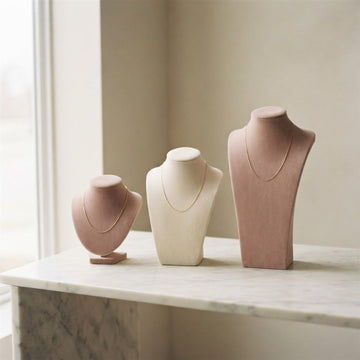
Essential for adding verticality and silhouette. In the display window, mix sizes and heights (mini bust 18 cm, medium bust 35 cm, large bust 60 cm) to structure the space.
Ring supports
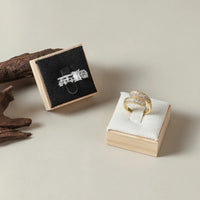
They create precision, detail, and perceived value. A ring display on several levels works particularly well for solitaires and wedding rings.
Trays and cushions
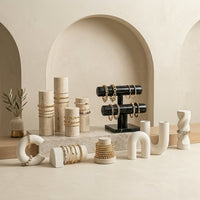
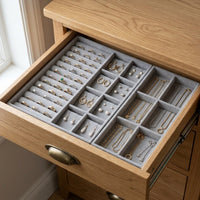
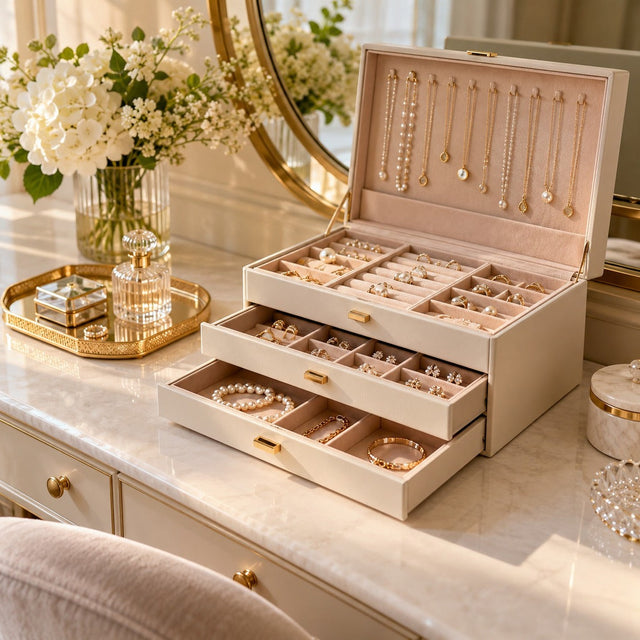
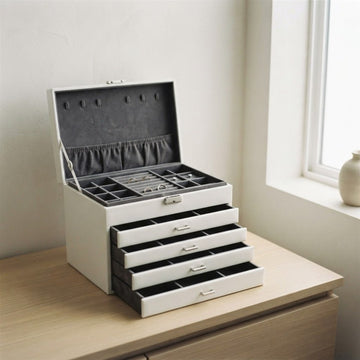
They dress the lower zones and create visual steps. Round trays, square trays, mini cushions: they allow you to group pieces by family (earrings, bracelets, rings).
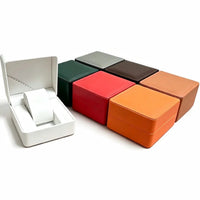
Open cases and boxes
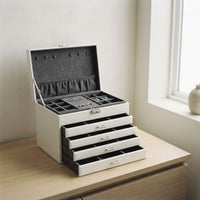
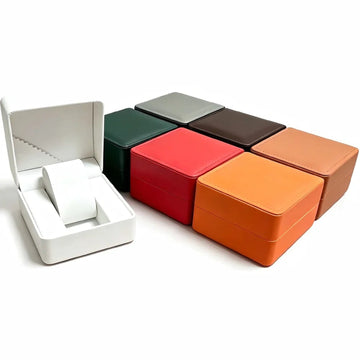
A slightly open box on an exceptional piece immediately triggers the idea of a gift. Very effective during the holidays, birthdays, Valentine's Day.
Creating a jewelry display window step by step
To apply everything that precedes, always follow the same order. It prevents moving everything at the end of the day because a detail is not working.

Prepare: empty, clean, choose a message
Remove everything that is in the display window, clean the glass and the background, then decide what the display window should tell: a season, a collection, a flagship piece. One message is enough.
Place: from highest to lowest
First install the highest display, at the left or right third, then the medium supports, finally the trays. Place the jewelry last, once the structure is stable.
- Empty and clean the display window.
- Choose the focal point and the flagship piece.
- Place the displays, from highest to lowest.
- Place the jewelry, then adjust the lighting.
- Step back and check from the sidewalk.
Check: the sidewalk test
Step back to the opposite sidewalk and look at the display window for a few seconds, then close your eyes: what remains in your mind? If it is the flagship piece, the composition works.
Otherwise, remove an object rather than adding one. A display window is almost always corrected by simplifying.
Bringing the display window to life throughout the seasons
An identical display window from January to December becomes an ignored display window. The neighborhood customer passes by twice a day: they lose interest as soon as nothing changes. The rule: four major changes per year, and a minor change every month.

| Season | Palette | Pieces to highlight | Decor |
|---|---|---|---|
| Spring | Pastel, cream, soft green | Fine pieces, pearls, light stones | Flowering branches, linen, light marble |
| Summer | Gold, sand, lagoon blue | Sunny pieces, hoop earrings, fine chains | Sand, shells, raffia |
| Autumn | Camel, terracotta, plum | Rose gold, amber, warm stones | Wood, dried leaves, velvet |
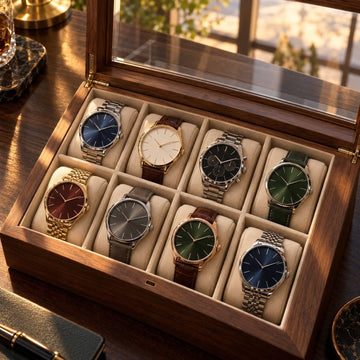
| Winter / Holidays | Burgundy, pine green, gold | Exceptional pieces, wedding rings, watches | Deep velvet, open cases, golden light |
Prepare your next display window change
Vary the displays, the cushions, the trays: a new decor every three months is enough to restart foot traffic in the store.
Discover our displaysJewelry display in a small space: counter, stand, or interior display window
The principles remain the same when space is limited: a focal point, multiple heights, and controlled lighting. Only the proportions change.

The counter: a display at eye level
On a counter, the customer looks closely. Opt for low displays and multi-level trays, and reserve a medium-sized bust to catch the eye.
The trade show stand: multiple sides to consider
A stand is often viewed from the front and the side. Place the flagship piece high at the back, medium supports on the sides, and keep the front clear so visitors can approach without obstruction.
The indoor display: the background sets the scene
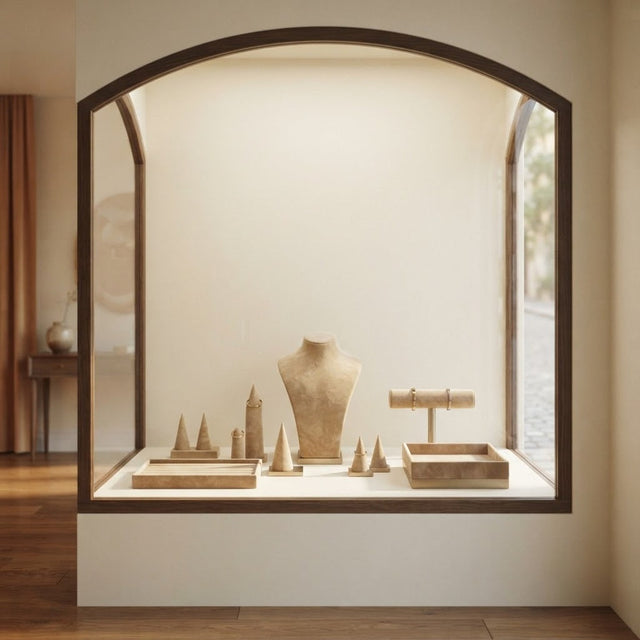
In a closed display case, the background takes up a large part of the image. Choose a solid color that highlights the metal, and leave free space around each piece so it can breathe.
| Space | Priority | Suitable displays |
|---|---|---|
| Counter | Quick, close-up viewing | Trays, small busts |
| Trade show stand | Visibility from multiple sides | Busts of varying heights, ring holders |
| Indoor display | Background and lighting | Busts, cushions, cases |
Maintain your display and check that it works
A beautiful display stays that way if you keep an eye on it. A few regular actions and a simple check prevent it from going dark without you noticing.
Weekly tasks
Clean the glass, dust the velvet displays with a soft brush, and check the stability of the tall busts. Also check that each spotlight always illuminates the intended piece.
Spotlight and cable safety
Have the lighting installed and checked by an electrician: cables out of reach of passersby, spotlights securely fixed, no overloaded power strips. For valuable pieces, also seek advice from a security professional.
The display journal
Photograph the display at each rotation and note the date and the flagship piece. By comparing it with foot traffic and customer feedback, you will identify the compositions that really slow down passersby.

Our favorite displays for a display that catches the eye
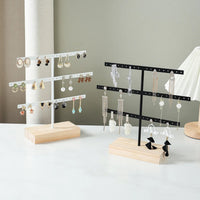
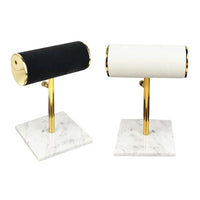
Four references show how to add depth to a display: the beige velvet display, the black velvet display, the microfiber busts, and the hexagonal wooden tray. Choose a coherent family of materials and shades.


To go further, explore the velvet jewelry display and metal jewelry display collections.
The pitfalls that make a display invisible
- Too many pieces: beyond 25 to 30 pieces of jewelry in a standard display, the eye no longer settles.
- Uniform height: everything at the same level = everything ignored.
- Light that is too warm or too cold: jewelry looks yellow or blue, less desirable.
- Reflections from the street: poorly oriented spotlight, insufficient interior light, dirty glass.
- Static display: no change for 6 months = loyal customers who no longer look.
- Disparate displays: colors, materials, and finishes that do not harmonize.
- No focal point: everything is important = nothing stands out.

FAQ – Jewelry Display
How many pieces of jewelry should be displayed in a display?
For a display that is 1 meter wide, count on 15 to 25 pieces. Beyond 30, the composition becomes unreadable. It is better to let each piece breathe than to try to show everything.
How to avoid reflections in the display?
Increase the interior light, point the spotlights downwards rather than directly at the display, use anti-reflective glass when possible, and clean the glass every day.
At what height should the flagship piece be placed?
Ideally between 1.30 m and 1.55 m from the floor on the street side, that is, at an adult's eye level. Above that, the jewelry is too high; below that, it is ignored by standing passersby.
What light temperature is best for a jewelry display?
Mix 2700 K to 3000 K for warmth in the ambiance, and 3500 K to 4000 K for accent lighting to make the stones sparkle. Avoid 5000 K and above, which gives a cold hospital look.
How often should a display be updated?
Four major rotations per year, and a mini-change every month. This is the pace that maximizes customer returns to the store from the neighborhood.
What displays should be chosen for a small display?
Opt for two or three short busts, one tray, a ring display, and a mini cushion. Material consistency (for example, sand velvet + ecru linen) matters more than quantity.
Should prices be displayed in the window?
For medium pieces, yes: it qualifies the customer and reassures. For exceptional pieces, only the mention "on request" is indicated to preserve the staging.
How to highlight a necklace in a display?
Present it on a bust, at a height that catches the eye, with a directional spotlight. One necklace per bust, without any other piece around it, is enough to make it the focal point.
Should all ranges be displayed in the same display?
No: a display that shows everything tells nothing. Choose a message, a season, a collection, or a flagship piece, and keep the rest for the inside of the store.
How to know if a display is working?
Do the sidewalk test: step back, look for a few seconds, and check that the flagship piece remains in mind. Also observe if passersby slow down or stop, and note customer feedback.
Get our next articles
Tips, guides and new arrivals, straight to your inbox.