

























Single or multi-jewelry display: which one to choose for a shop window?
Individual display or multi-jewelry display: a strategic choice

Should you favor an individual or multi-jewelry display in your jewelry store window? This question, seemingly technical, actually determines the commercial effectiveness of your point of sale. The individual display highlights a centerpiece, isolated and desirable. The multi-jewelry display structures an offering, tells the story of a collection, and provides an overview.
The two formats serve different sales intentions, and using them correctly makes all the difference between a window that goes unnoticed and one that converts.
Individual display vs multi-jewelry display: clear definitions
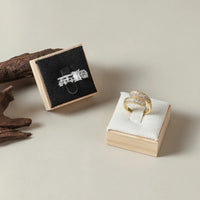
An individual display is designed to showcase a single piece of jewelry: a signature ring, a unique pendant, or an iconic pair of earrings. It plays a role in highlighting a visual hero.
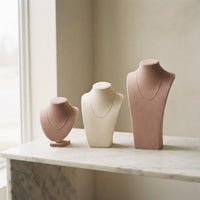
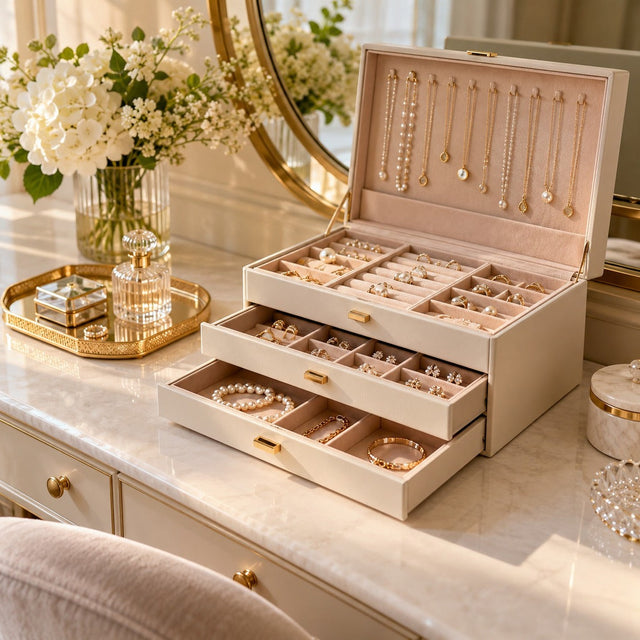
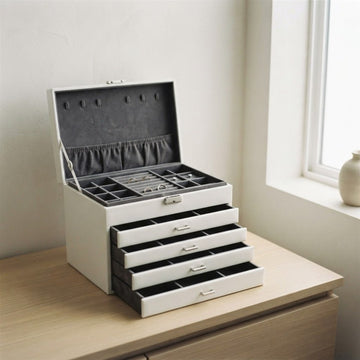
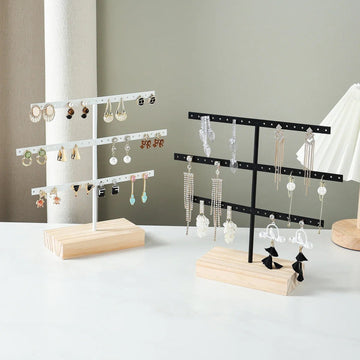
In contrast, a multi-jewelry display presents several pieces simultaneously. This includes jewelry trays, busts holding multiple layered necklaces, bars aligning 8 to 12 rings, and earring boards.
Neither is inherently superior to the other. Their effectiveness depends on your intention, your catalog, and the customer journey you want to create.

The strengths of the individual display

The individual display is the ultimate tool for creating desire.
1. It maximizes perceived value
A piece isolated on a dedicated display is instantly perceived as exceptional. This is a fundamental psychological principle: what is rare appears valuable.
2. It guides attention
In a window where the customer's gaze has only a few seconds to catch on, the individual display acts as a focal point.
3. It elevates signature pieces
Every designer has one or two pieces that define their style. On an individual support, they become the brand's visual identity.
4. It photographs beautifully
For your e-commerce, lifestyle, or social media visuals, the individual display is unbeatable.
The strengths of the multi-jewelry display

The multi-jewelry display is the ultimate tool for choice and volume.
1. It optimizes space
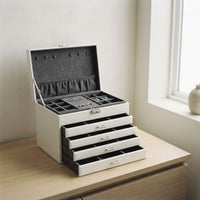
A 35 x 24 cm tray can hold 6 to 8 pieces. The surface-to-displayed-jewelry ratio is unbeatable.
2. It facilitates comparison
Presenting 10 wedding rings side by side allows the customer to compare widths, finishes, and colors.
3. It triggers multiple purchases
Seeing a complete collection allows customers to imagine how several pieces could match: stacking bangles, layering necklaces.
4. It tells the story of a collection
A theme, a universe, a season: all of this is better told through a cohesive ensemble.
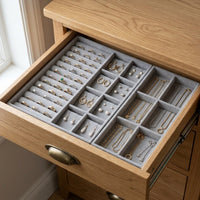
Discover our multi-jewelry trays
Ideal for structuring a collection, comparing several pieces, and triggering multiple purchases.
View jewelry traysWhich format to choose according to your situation?
| Situation | Recommended format | Why |
|---|---|---|
| Signature piece to highlight | Individual | Maximizes desire and perceived value |
| Large wedding ring catalog | Multi-jewelry (aligned bar) | Allows direct comparison |
| Christmas window or special event | Mix: 1 hero + 4-5 secondary pieces | Creates a focal point and a universe |
| Artisan market stand | Multi-jewelry dominant | Optimizes space and visible volume |
| High-end jewelry store | Individual dominant | Reinforces the premium image |
| E-commerce product photos | Exclusive individual | Offers the best readability |
| Lifestyle / collection photos | Multi-jewelry | Tells a complete universe |
| Unique artisan creation | Individual | Highlights the designer piece |
| High-volume costume jewelry | Multi-jewelry | Allows covering the large catalog |

Combining the two: the winning hybrid strategy

The best answer to the question "individual or multi-jewelry" is actually: both, intelligently.
The 1/3 - 2/3 rule
Allocate about one-third of the space to individual displays (hero, signature pieces, premium pieces) and two-thirds to multi-jewelry displays (collections, wedding rings, complementary ranges).
The hero and the soldiers
Identify one "hero" piece to display alone each season, and arrange thematic multi-jewelry displays around it.
The gaze diagonal
Place the individual display on the main diagonal (generally top-left to bottom-right in Western reading).
Three heights, two types
Combine three display heights (top, middle, bottom) with the two types (individual, multi).
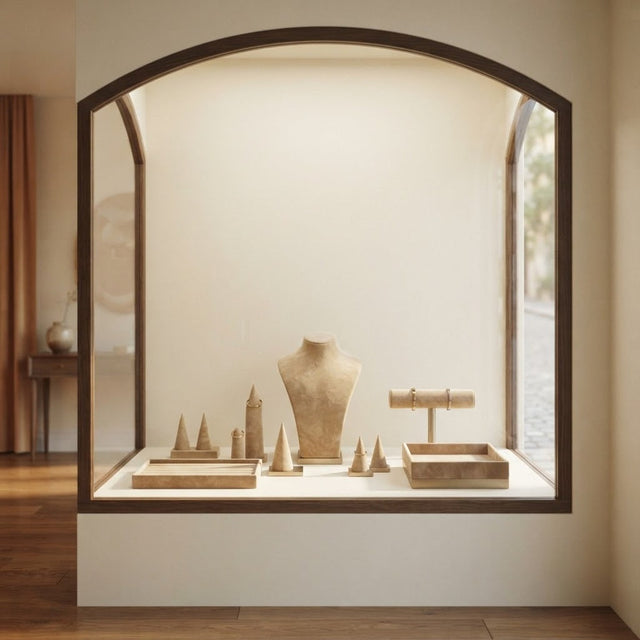
Create a balanced individual + multi window
From the ring bar to the necklace bust, create your hybrid strategy.
View all displaysLayout mistakes to avoid
- All multi-jewelry: your window looks like a "flea market", without hierarchy.
- All individual: empty window, feeling of a sparse catalog.
- Displays too close: the jewelry blends together. Allow at least 5 cm between two supports.
- Uniform height: flat alignment, no relief.
- Individual display used for a non-heroic piece: isolating a basic ring simply makes it look odd.
- Saturated multi-jewelry: 12 layered necklaces on a bust create an unreadable knot.

How to decide concretely?

- What is the average size of my catalog? Less than 30 pieces: individual. More than 80 pieces: multi-jewelry.
- What is my average selling price? Over €200: individual. Accessible pieces: multi-jewelry.
- Where do I sell? Premium boutique: individual. Market, trade show, high-volume e-commerce: multi-jewelry.
Individual or multi-jewelry display according to the jewelry: ring, necklace, earrings, bracelet
The choice is not only made according to the window: the type of jewelry matters just as much. Each family has a format that favors it, individual for the statement piece, multi-jewelry for the range.
Rings: a cone for the statement piece, a bar for the range
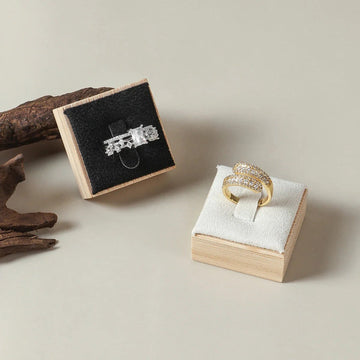
A signature ring benefits from being alone on a small cone or cube. For a wide choice of wedding rings or fine rings, the aligned bar or slotted tray allows for comparison.
Necklaces: an isolated bust or a bust that tells a style
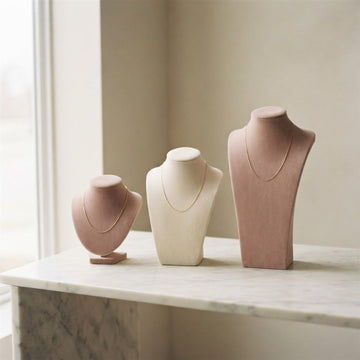
A bust wearing a single necklace showcases the piece. A bust wearing two or three necklaces of different lengths shows how to layer them. Beyond that, the reading becomes confusing.
Earrings: a signature pair or a complete board
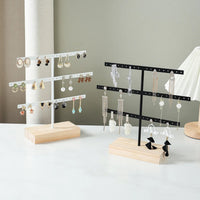
An iconic pair is presented on a small individual support. When the range is wide, the perforated board or the branched tree displays several pairs at once, with the spacing they require.
Adornments: a set on the same support
An adornment, that is, a necklace and its matching earrings, is presented as a single block on a bust or a common tray. The customer immediately sees the complete set.
Bracelets and watches: a cylinder or a T-bar
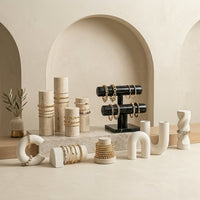
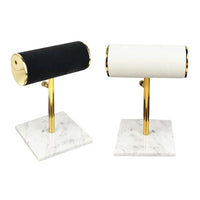
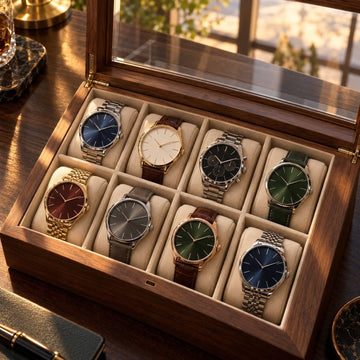
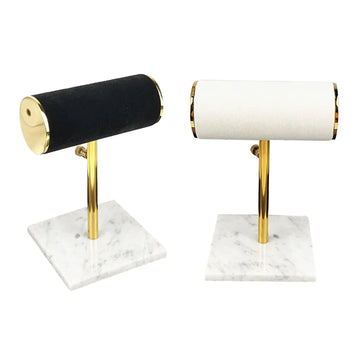
An exceptional bangle is shown on a single cylinder. A series of bracelets or watches aligns on a T-bar, which keeps each piece visible without stacking them.
| Jewelry | Individual for | Multi-jewelry for |
|---|---|---|
| Rings | A signature ring | Compare wedding rings |
| Necklaces | A showcased necklace | Show layering |
| Earrings | An iconic pair | A complete range |
| Bracelets | An exceptional bangle | An aligned series |

Staging a single-piece display
A single-piece display allows no room for approximation: the piece is alone, everything is visible. The support, background, and lighting must therefore serve the jewelry, never compete with it.
Choose a support that recedes before the piece
An understated support, in a neutral shade and modest proportions, lets the jewelry speak. A support that is too decorative draws the eye away from the piece it is meant to serve.
Carefully consider the background and surrounding space
A plain background and clear space around the support give the piece its importance. Remove any object that adds nothing: a single decorative element is enough.
Illuminate without glare
Soft lighting, coming from above or from the side, brings facets and reflections to life. Avoid direct reflections on the support or the glass, which obscure the piece.
Size the support according to the piece
The support should remain more discreet than the jewelry: a base wide enough to be stable, and a height that brings the piece to eye level. If the support catches the eye before the piece, it is too large.
Change the hero piece every season
The single-piece display is the easiest to update: you change the piece, not the display case. This renewal gives regular customers a reason to stop by again.

Creating a multi-piece display without overwhelming it
A successful multi-piece display can be understood at a single glance. The risk is trying to show everything: the more pieces there are, the more order matters.
Group pieces by family
Gather jewelry of the same type, material, or shade. The customer understands the logic effortlessly and can compare more quickly.
Alternate full and empty spaces
Deliberately leave a few empty spaces. These gaps rest the eye and make the neighboring pieces stand out. A completely full tray looks cluttered.
Respect the capacity of the support
Every support has its limits: a standard tray holds 6 to 8 pieces, a bar holds 8 to 12 rings, and a bust holds 2 to 3 necklaces. Exceeding these guidelines impairs readability and damages the jewelry.
Clean surfaces regularly
Velvet and fabric trap dust, which dulls the jewelry. Use a small soft brush or a dry cloth before every opening: a clean support enhances the entire displayed range.
Vary heights to guide the eye
On the same tray or shelf, alternate two or three levels. Pieces placed higher catch the eye first, while those below hold it. This alternation avoids the flat row effect.
Establish a reading order
The eye moves from left to right. Place the entry-level pieces of the theme on the left, then the more elaborate ones toward the right. The customer naturally follows the path.

Single-piece or multi-piece display depending on the point of sale
The same range is not presented the same way in a boutique, at a market, or on an online sales site. The location determines the available space, the duration of attention, and the expected level of detail.
In a premium boutique: single-piece displays dominate
In a high-end boutique, the customer takes the time to look. Few pieces, large empty spaces, single-piece displays: scarcity creates a premium image.
At a market or trade show: multi-piece displays dominate
At a stand, space is limited and passersby move quickly. Aligned trays and bars show many pieces in a small space. Keep one or two single-piece displays to catch the eye.
For online sales: choose according to the photo
A product photo is better understood with a single-piece display: the piece is clear and isolated. Lifestyle photos, on the other hand, benefit from showing a multi-piece display that tells a complete story.
At home: the dressing table and the shelf
For personal use, the multi-piece display organizes, while the single-piece display decorates. A tray or bust gathers everyday pieces, while a small isolated support highlights the favorite piece within easy reach.
For a special promotion: a hero and a few supporting pieces
A holiday or launch display consists of a featured piece on a single-piece display, surrounded by a few pieces on a multi-piece display. The focal point is clear, and the overall theme is cohesive.

Choosing the materials and shades for your displays
Whether single-piece or multi-piece, a display is also judged by its material and color. These two choices set the tone of the display before the customer even looks at a piece of jewelry.
| Material | Atmosphere | Pairs well with |
|---|---|---|
| Velvet | Soft, warm | Shiny or set pieces |
| Wood | Natural, artisanal | Original designs, minimalist jewelry |
| Clear acrylic | Light, contemporary | Delicate pieces, small displays |
| Metal | Graphic, modern | Varied ranges, large volumes |
One dominant shade, two at most
Limit the display to one dominant shade and one accent shade. The single-piece displays and multi-piece displays will then appear to be part of the same collection, even if their shapes differ.
Contrast the support and the jewelry
A gold piece stands out against a dark or deep background, and a silver piece against a warm background. If the support is the same color as the piece, it gets lost. Contrast does the work of a spotlight.
Maintain consistency from one season to the next
Change the pieces rather than the supports. A consistent base over time establishes your visual identity, and the display becomes instantly recognizable.
Our favorites: four single-piece and multi-piece displays
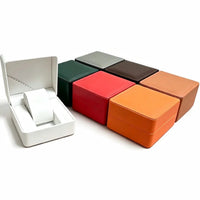
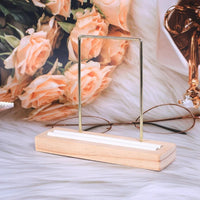
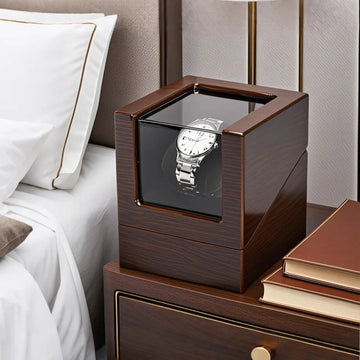
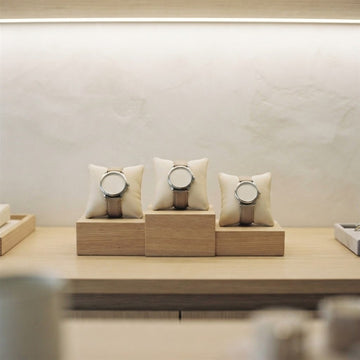
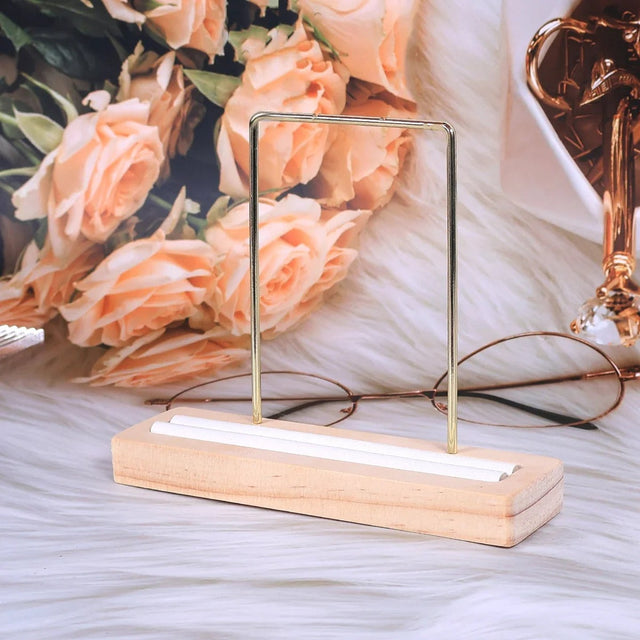
These four models illustrate the two approaches: a support for showcasing a ring, frames for earrings, a bust for a necklace, and a tray with slots for grouping a range. Always check the dimensions on the product page.


Conclusion: the right combination makes the sale
Choosing between a single-piece or multi-piece display is not about choosing one over the other, but about orchestrating them. The former creates desire, while the latter structures the offering. The best-selling jewelry stores do not choose: they balance them.

FAQ: single-piece or multi-piece display
When should I use a single-piece display instead of a multi-piece display?
For a signature piece over €150-200, a unique creation, a special promotion, or for your e-commerce product photos.
How many single-piece displays should I have per display case?
One "hero" single-piece display per display case, sometimes two if the display case is very wide.
Does a multi-piece display detract from a premium image?
Not at all, provided it is presented with care: even spacing, perfect alignment, and premium materials.
For a market stand, should I favor multi-piece displays?
Yes, for roughly 70–80%. But keep 1 or 2 single-piece stands for your most desirable pieces.
Can I use a bust to display several necklaces?
Yes, by layering a maximum of 2 to 3 necklaces of different lengths and thicknesses.
Which format is best suited for e-commerce photos?
A single-piece display, without question. For lifestyle or collection photos, switch to a multi-piece display.
What is the minimum distance between two displays?
5 cm between two different supports, and at least 2 cm between two pieces on the same multi-piece display.
Which display should I choose for an engagement ring?
A single-piece display: isolated on a small support, the ring becomes the hero piece of the display case.
How should I light a single-piece display?
With soft lighting coming from above or from the side, avoiding direct reflections on the support or the glass.
How many pieces of jewelry should I put on a multi-piece display?
A standard tray holds 6 to 8 pieces, an aligned bar holds 8 to 12 rings, and a bust holds 2 to 3 necklaces. Leave a few empty spaces.
How should I group jewelry on a multi-piece display?
By family: the same type of jewelry, material, or shade, so that the customer understands the logic at a single glance.
Can I use several display formats in one display case?
Yes, it is even recommended: a single-piece display for the hero piece, multi-piece displays for the rest, at three different heights.
Get our next articles
Tips, guides and new arrivals, straight to your inbox.