

























What display size should you choose based on the type of jewelry?
Why adapt the display size to the type of jewelry

Choosing the right jewelry display size is one of the best-kept secrets of jewelry stores that really sell. Too small, the stand disappears and makes the jewelry look disproportionate. Too large, it overwhelms the piece and creates a sense of emptiness.
Conversely, the right format instantly enhances a ring, brings movement to the drape of a necklace, and adds rhythm to a row of bracelets. This guide details, jewelry type by jewelry type, the ideal dimensions of a display: height, width, depth, space between pieces, and golden rules to never make a mistake.
The golden rule of dimensions: proportion and breathing room
Before going into detail about each type of jewelry, keep two universal principles in mind. First, the 1:3 proportion rule: the visible height of the jewelry should never exceed one-third of the height of the display. A 45 cm necklace placed on a 50 cm bust, for example, "crushes" the stand.
Conversely, a 35 cm bust for this same necklace looks tiny.
Next, visual breathing room: always leave free space around each piece of jewelry equivalent to at least 30% of the surface it occupies.
Measure before buying: an essential step
Before placing any order, note: the available height in your display case, its usable depth, the average length of your necklaces, the inner diameter of your bracelets, the number of rings to display simultaneously. These five measurements are enough to choose a display perfectly.

Ring display: which dimensions to choose?

The ring display is probably the most demanding in terms of dimensions. Since a ring is small, it must be displayed precisely so it does not get lost in the stand.
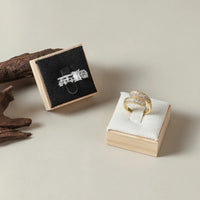
Individual ring display
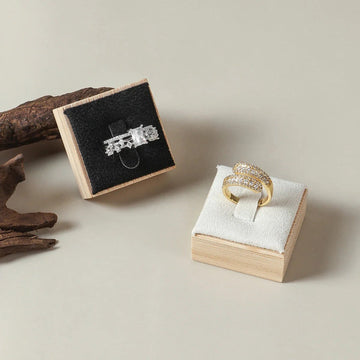
Allow for a height between 5 and 8 cm for a freestanding individual display. The base should be about 4 to 6 cm wide for perfect stability. This is the ideal format to showcase a signature piece, an engagement ring, or a solitaire.
Multi-ring display (aligned bar)
For an aligned presentation bar, allow for a length of 12 to 25 cm to display 6 to 12 rings, spaced 1.5 to 2 cm apart. The ideal height is between 4 and 6 cm.
Ring tower or pyramid display
Tower, pyramid, or column displays allow you to display 15 to 30 rings on multiple levels. Recommended height: 20 to 30 cm.
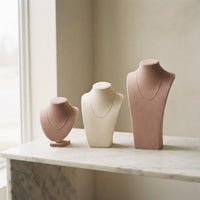
Necklace display and bust: the right height
The necklace bust is probably the display where the dimension is most determining. The wrong height completely distorts the perception of the jewelry.
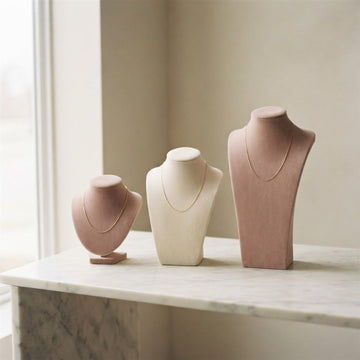
Short busts (28-34 cm)
Perfect for chokers, chokers, and short chains (38 to 42 cm). They are also ideal for necklaces by young designers with minimalist designs.
Medium busts (35-42 cm)
The most versatile format, which works for the majority of necklaces between 42 and 50 cm. This is the height chosen by most jewelry stores.
Tall busts (45-55 cm)
Essential for long necklaces, long necklaces (55 cm and more), and heavy pendants that need to drape.
T or L stands
A sleek alternative to the bust, these vertical stands are generally 25 to 40 cm high, with a top width between 10 and 18 cm.
All bust formats for your necklaces
Discover our selection of necklace busts, from the short choker to the long necklace.
View our necklace busts
Bracelet display: length and diameter

For bracelets, two dimensions matter: the length of the display and the diameter of the stand.
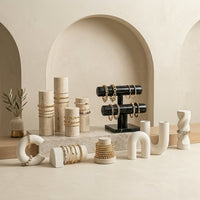
Cylindrical bracelet display
The standard diameter is 6 to 7 cm. Too small, the bracelet hangs poorly; too large, it stretches and deforms. The height of the cylinder is around 5 to 12 cm.
Horizontal bracelet display
To align 4 to 8 bracelets side by side, allow for a length of 25 to 40 cm. The height can remain low (3 to 6 cm), with a depth of 8 to 10 cm.
Half-moon bracelet display
Ideal for cuffs and wide bangles. Recommended width: 12 to 15 cm, height 6 to 9 cm.
Earring display: usable surface

The earring display follows a logic of surface: you need enough holes, slots, or bars to display your entire range without saturating.
Individual or single pair display
To showcase a signature pair, choose a display 5 to 10 cm high. Ideal for statement pieces.
Perforated multi-pair display
Allow for a surface of 15 x 20 cm minimum to display 8 to 12 pairs comfortably, with a spacing of at least 2.5 cm between each pair. For a large display case, go up to 25 x 35 cm for 25 to 30 pairs.
Hanging display (wall-mounted or rotating)
Height 30 to 60 cm, width 20 to 40 cm. Allows you to align 30 to 80 pairs depending on the model.
Optimize your earring presentation
Perforated plates, individual stands, rotating displays.
View our earring displaysTrays and multi-jewelry displays
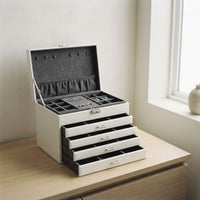
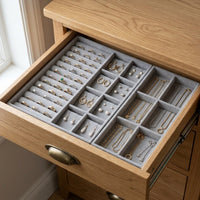
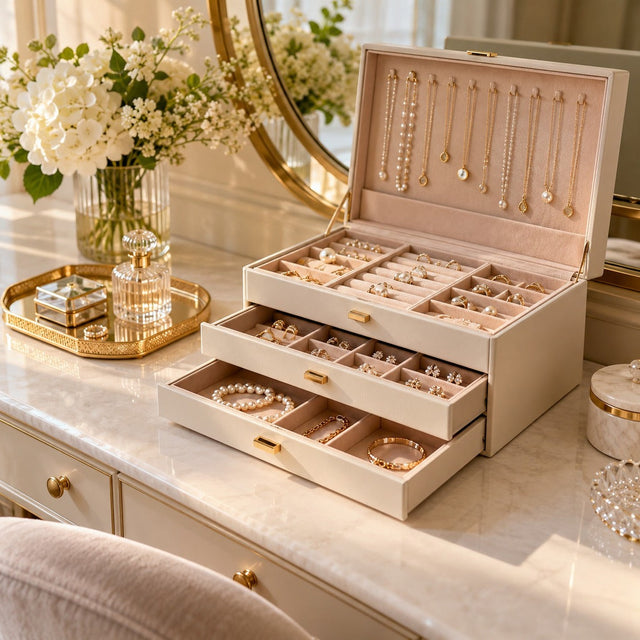
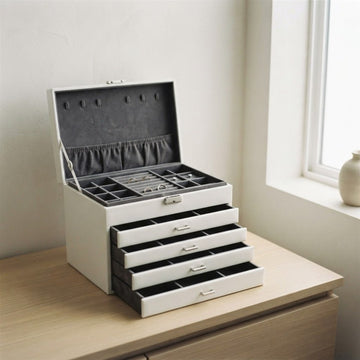
Jewelry trays are the most modular solution for displaying several types of pieces simultaneously.
- Half-tray format: 24 x 17 cm. Perfect for targeted showcasing.
- Standard tray format: 35 x 24 cm. The most common in professional jewelry stores.
- Large tray format: 38 x 27 cm or even 40 x 30 cm. Recommended for main display cases.
- Depth: between 1.5 and 4 cm depending on the type of insert.

Summary table of standard dimensions

| Display type | Recommended height | Width / length | Capacity |
|---|---|---|---|
| Individual ring | 5-8 cm | 4-6 cm | 1 signature piece |
| Aligned ring bar | 4-6 cm | 12-25 cm | 6-12 rings |
| Ring tower | 20-30 cm | 10-15 cm | 15-30 rings |
| Short necklace bust | 28-34 cm | 15-18 cm | 1 choker |
| Medium necklace bust | 35-42 cm | 18-22 cm | 1 necklace 42-50 cm |
| Tall necklace bust | 45-55 cm | 20-25 cm | 1 long necklace |
| Cylindrical bracelet display | 5-12 cm | 6-7 cm Ø | 1-3 bangles |
| Horizontal bracelet display | 3-6 cm | 25-40 cm | 4-8 bracelets |
| Earring plate | 2-3 cm | 15x20 to 25x35 cm | 8-30 pairs |
| Standard jewelry tray | 1.5-4 cm | 35x24 cm | multi-jewelry |
How to combine these formats in a display case?
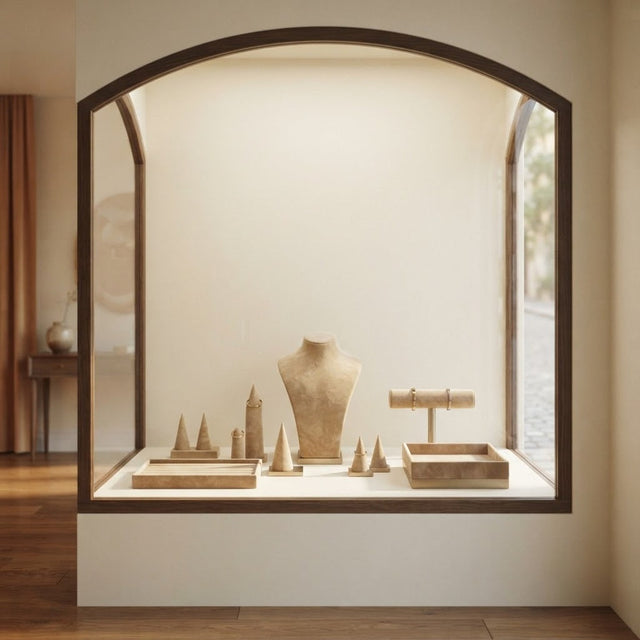
The simple rule: a tall bust, a medium bust, a low tray, plus 2 to 3 individual stands for the statement pieces. This combination naturally creates the three heights necessary for a professional display case.
Adapting the display size to the display case and counter
A display is chosen for the jewelry, but it lives in a specific space. A deep display case and a narrow shelf do not accommodate the same stands. Before comparing models, measure the dimensions of the location.
Measure the usable height, width, and depth
The usable height stops under the lighting or under the top shelf. The usable depth excludes the edge of the glass and the area that the hand does not reach.
Also note the free width between two uprights: a stand too wide for the location forces you to move everything on the day of setup.
Leave room for the eye to move around each stand
As with jewelry, leave free space around each stand. The eye must move from one piece to another without bumping. A display pressed against the glass or its neighbor looks cramped, and the jewelry loses its relief.
Allow margin for the next collection
A display case is renewed throughout the seasons. Choose formats that can change place without having to redo everything: a stable base, a common height, a neutral shade.
Also keep a small reserve of free space. If a new piece arrives, you can add it without crushing the others.
Test the arrangement beforehand before ordering
Cut out the footprint of each stand, base included, from cardboard, then place these templates in the display case. You will immediately see if the heights interfere with each other, if a shelf hides a bust, or if two bases touch.
This ten-minute test costs less than a return order, and it confirms that the chosen display size really suits the location.

T-display, bar, or bust: which stand for which jewelry?
The right format depends first on how the jewelry is worn. A bracelet wraps, a ring stands upright, a necklace drapes, an earring hangs. Each gesture calls for a different support.
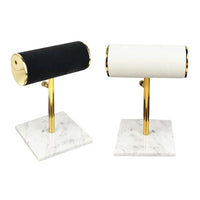
The T-shaped display for bracelets and watches
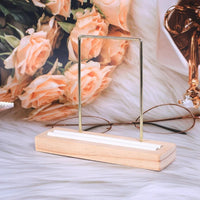
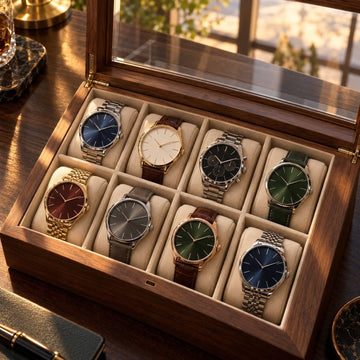
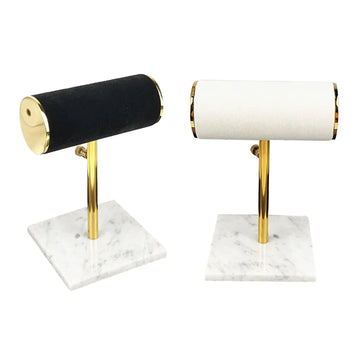
The T-shaped stand, a horizontal bar on a base, holds bracelets, bangles, and watches. The longer the bar, the more pieces you can align.

For more than a few bracelets, opt for two tiered bars rather than one overcrowded bar: every piece remains visible.
The bar or slotted tray for comparing rings
A bar or slotted tray holds rings upright. The customer can compare the width and finish at a glance. Follow the spacing indicated above so that two rings do not touch.
The bust for letting the necklace drape
The bust recreates the neckline: the necklace drapes naturally and the pendant finds its place. Refer to the three bust heights detailed above to choose the one that matches the chain length.
Combining several formats without mixing them up
The same display case can hold a bust, a ring bar, and a T-shaped stand. To keep the overall look clear, use the same material or color from one stand to the next: the shapes vary, the decor remains cohesive.
The plate or tree for earrings
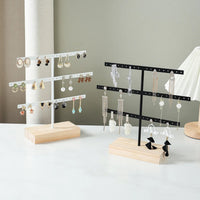
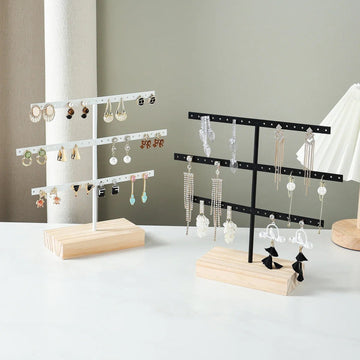
The perforated plate is suitable for a large number of pairs. The tree, with several branches, takes up less floor space and is easier to view from the front. In both cases, allow for the surface area per pair indicated in the FAQ.
| Jewelry | Support | Size guide |
|---|---|---|
| Bracelets | Cylinder or horizontal bar | 6 to 7 cm in diameter or 25 to 40 cm long |
| Rings | Aligned bar or tower | 12 to 25 cm long, or 20 to 30 cm high |
| Necklaces | Bust or T or L-shaped stand | 28 to 55 cm high depending on the chain |
| Earrings | Perforated plate or tree | 15 x 20 cm for 8 to 12 pairs |
Presenting jewelry on a table: counter, living room, or market
On a table, there is no display case background or built-in lighting. Everything depends on the choice of sizes and their arrangement. The same height guidelines apply, with one extra consideration: that everything can be easily assembled and disassembled.
Arranging the display in layers
Create depth with three levels: a bust or tall stand at the back, medium stands in the middle, and low trays at the front. The customer sees every piece without another one obscuring it.
Choosing lightweight and easy-to-store formats
A stand is assembled and stored multiple times. Opt for stackable trays and stands that can be disassembled. A display that is too bulky will end up staying in its box.
Thinking about lighting on a table
Without built-in lighting, the light comes from the room or a window. Avoid placing a tall stand in front of a light source: its shadow would fall on the neighboring jewelry. A low tray at the front, on the contrary, benefits from all the available light.
Keeping a clear strip at the front of the table
Leave a clear area in front of the first stands: the customer leans in, looks, then touches. Place the most desirable pieces at the front and set the complementary ranges further back.

Our favorites: four displays to get started
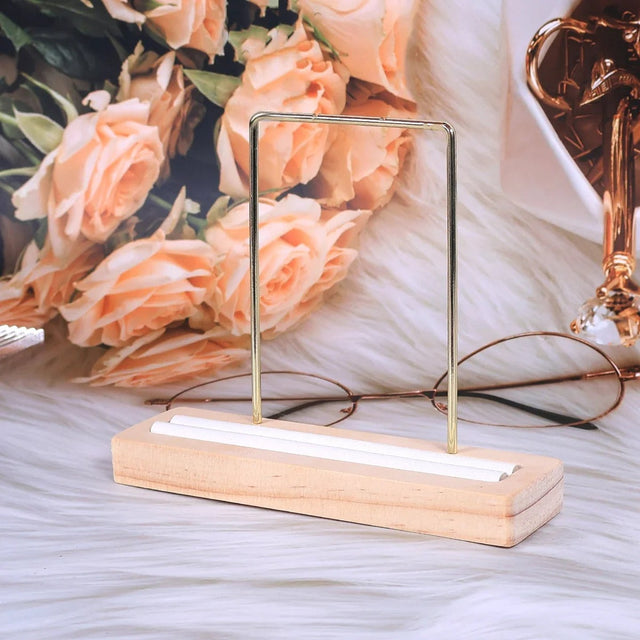
These four models cover the main uses mentioned in this guide: a bust for necklaces, a bar stand for bracelets, a branch stand for earrings, and a tray to bring together several pieces. Always check the dimensions indicated on each product page.


Conclusion: the right size makes the right sale
The jewelry display size is not a matter of taste but of sales strategy. Each type of jewelry has an optimal format that maximizes its visibility, perceived value, and therefore its chances of being purchased. Before ordering, take 10 minutes to measure your pieces and your space: it is the most profitable investment.

FAQ: display sizes and formats
What display size for a 45 cm necklace?
A medium-height bust between 35 and 42 cm is perfect for a 45 cm necklace. It respects the 1:3 proportion rule and restores the natural drape of the jewelry.
How many rings can be displayed on the same stand?
A standard 20 cm aligned bar comfortably holds 8 to 10 rings, with 2 cm spacing. A 25 cm tower allows you to display 20 to 25 rings spread over several levels.
What diameter for a bracelet display?
The standard diameter of a cylindrical display is 6 to 7 cm. For wider bangles, go up to 8 or 9 cm.
What surface area to allow for an earring display?
Allow about 5 cm² per pair. A 15 x 20 cm plate holds 10 to 12 pairs, and a large 25 x 35 cm format holds up to 30 pairs.
What is the ideal depth for a jewelry tray?
Between 1.5 and 2 cm for fine and flat jewelry, and 3 to 4 cm for bulky pieces.
Should you choose the same format for all your displays?
On the contrary: the variety of heights and formats creates rhythm in the display case. Always combine several sizes to guide the customer's eye.
What display size for an engagement ring?
An individual stand 5 to 8 cm high, with a 4 to 6 cm base, highlights the ring without crushing it.
What bust height to choose for a choker?
A short bust, 28 to 34 cm, is suitable for chokers and short chains of 38 to 42 cm.
How to choose the length of a T-shaped display?
Allow 25 to 40 cm to align 4 to 8 bracelets, at a low height of 3 to 6 cm. Beyond that, switch to two tiered bars.
What space to leave between two displays?
Leave around each piece of jewelry a clear space of at least 30% of the area it occupies. For earrings, keep at least 2.5 cm between two pairs.
How to present jewelry on a market table?
Set up three levels: a tall stand at the back, medium stands in the middle, low trays at the front. Leave a clear strip at the front so the customer can look.
Should you measure your display case before buying a stand?
Yes. Note the available height, the useful depth, and the free width: these measurements prevent you from ordering a stand that won't fit.
Get our next articles
Tips, guides and new arrivals, straight to your inbox.