
























Is a bust display or a flat stand better for necklaces?
Necklace bust or flat display: why the choice matters

Are you torn between a necklace bust display and a flat necklace display to showcase your pieces? You're not alone. It's one of the most common dilemmas in jewelry merchandising. The classic, inviting bust shows the natural drape and length of a necklace like no other display.
The flat display, with its more contemporary look, offers a clean, minimalist presentation, perfect for fine chains, sculptural pendants, and design-led displays.

Necklace bust vs. flat display: what really changes?
The necklace bust
A bust replicates part or all of the shape of a neck and upper torso. It comes in various heights (28 to 55 cm) and finishes (velvet, faux leather, painted resin). Its main purpose is to show the jewelry as it would be worn.
The flat display
A flat display is a horizontal display—often a tray, panel, frame, or small board—on which the necklace is laid flat. The jewelry is viewed like a drawing, like a graphic composition.
The strengths of a bust display

1. It shows how the necklace is worn
This is its number-one selling point. When customers see a necklace on a bust, they can picture wearing it themselves: its length, where the pendant falls, and how the chain sits on the neckline.
2. It showcases the length and drape
Laid flat, a long necklace looks like a long strand. On a tall bust, it comes into its own, showing its movement and elegance.
3. It stands out in the display window
A bust adds volume, height, and dimension to your display window. It creates a strong visual focal point.
4. It conveys a classic, welcoming feel
A bust evokes fine jewelry, a jewelry box, and tradition. It's an almost essential choice for traditional jewelry stores.
The strengths of a flat display

1. It reveals the jewelry's design
Viewed flat, a necklace becomes a graphic composition: its balance, shape, and details are all visible.
2. It fits a contemporary aesthetic
Concept stores, designer jewelry brands, and minimalist boutiques often opt for flat displays.
3. It makes efficient use of space
A flat display takes up space mainly across the surface, with little height.
4. It makes photo shoots easier
For overhead photos (flatlays), a flat display is unbeatable. Soft overhead lighting, free-form composition, and a changeable background.
All our necklace busts and displays
From classic velvet busts to contemporary flat displays.
Shop our necklace displaysWhich format for each type of necklace?

| Necklace type | Recommended format | Why |
|---|---|---|
| Choker (38-42 cm) | Short bust (28-34 cm) | Shows how it sits close to the neck |
| Princess-length necklace (42-48 cm) | Medium bust (35-42 cm) | Versatile format that shows the drape |
| Matinee necklace (50-58 cm) | Tall bust (45-55 cm) or flat display | Showing the length of the drape is essential |
| Long necklace (60 cm and over) | Tall bust is essential | Without enough height, the necklace will wrap around the bust |
| Asymmetrical necklace | Bust to show how it's worn, flat display to show the design | Each format highlights different aspects |
| Fine chain with pendant | Flat display or discreet T-bar stand | Avoids the heavy look of a bust |
| Sculptural necklace / statement jewelry | Flat display only | Shows the design as a graphic composition |
| Multi-strand necklace | Tall bust | Each strand needs to stand out |
| Layering (3 layered necklaces) | Bust only | Shows how the layers look when worn |
Which format suits your store's style?
Traditional jewelry store and fine jewelry boutique
Use busts as the main display, in black velvet or dark faux leather.
Contemporary designer boutique
A balanced mix: 50/50 busts and flat displays.
Concept store or minimalist brand
Make flat displays the main feature, in light wood, marble, or acrylic.
Craft market and pop-up stand
A tactical mix: one central bust for the hero piece, with several flat displays and trays for the rest of the collection.
Ethnic, boho-chic, and vintage jewelry
Flat displays on natural materials (raw wood, linen, stone), paired occasionally with a matte bust.

Bust or flat display for product photos?
Why choose a flat display for photos?
Flatlays have become standard on Instagram and Pinterest. Shoot from above, with soft overhead lighting and a free-form composition.
Why choose a bust for photos?
For front-facing product photos, the bust remains the go-to option. It shows how the necklace is worn.
Our recommendation
For every key piece, take one photo on a bust for the product page and one flatlay for social media.
Create your product photos with our premium busts
Velvet, faux-leather, and matte-resin busts.
Shop our necklace busts
How to combine the two formats effectively

1. Use the bust as an anchor and the flat displays to create breathing room
Place a central bust as a focal point and use flat displays around it to provide context.
2. Keep the colors coordinated
If your bust is black velvet, use light wood for your flat displays to create contrast.
3. Three heights, two formats
Use a tall bust, a flat display at medium height, and a low flat display. The eye naturally moves across all three levels.
What bust height should you choose for your necklace length?
The right bust is one that extends below the necklace's drape. If the jewelry is longer than the bust, it will wrap around it or drag on the base, losing its impact. Three heights cover almost every situation, as the table above shows.
Start with the necklace length
Measure the necklace laid out flat, from the clasp to the pendant. A choker is around 40 cm, a princess-length necklace around 45 cm, and a long necklace is over 60 cm. Compare this measurement with the usable height of the bust—that is, the section below the neck.
Allow a few extra centimeters
A bust that's a little taller than necessary is never a problem: the pendant hangs freely and customers have time to take it in. A bust that's too short, on the other hand, forces you to raise the chain or wrap it around the bust, and the piece loses its drape.
Keep three heights on hand
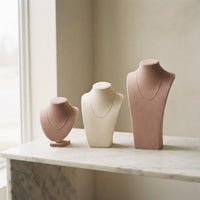
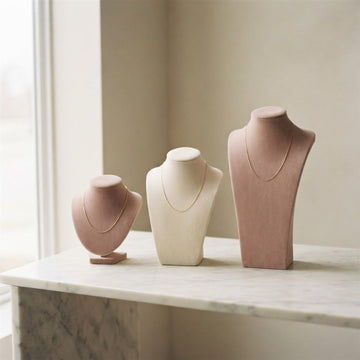
A short bust (28 to 34 cm), a medium bust (35 to 42 cm), and a tall bust (45 to 55 cm) are enough for a varied collection. These are the guidelines in the table above; the diagram below shows them side by side.
How to put a necklace on a bust, step by step
A successful display comes down to a few simple steps. Position the clasp at the back, let the chain follow the shape of the bust, and keep the pendant centered. Take the time to do it properly once, and your display will stay in place all day.
Fasten the necklace before placing it
Place the necklace around the bust with the clasp at the back, then fasten it before letting go of the chain. An unfastened necklace will slip at the first vibration from the display window.
Center the pendant
Align the pendant with the center line of the bust and let it hang freely. If a chain tends to twist, a small dab of discreet, repositionable adhesive putty, removed at the end of the day, will keep the jewelry facing forward.
Layer without tangling
For a layered look, place the shortest necklace first, then add the longer ones, spacing them two to three centimeters apart. Use no more than three necklaces on a tall bust, as noted in the FAQ below.
Remove without pulling
At the end of the day, undo the clasp before removing the chain. Pulling on a fastened necklace stretches the links and marks the velvet.

Which material and color make jewelry stand out?
The material and color of the display determine what customers notice first: the jewelry or the bust. The rule is simple: the display should fade into the background so the jewelry stands out.
Choose a contrasting background for each metal
A dark background, such as black velvet or dark faux leather, makes gold, bright silver, and pearls stand out. A light background, such as linen, beige microfiber, or light wood, suits colorful jewelry, dark stones, and highly graphic designs.
Matte or glossy?
A matte material absorbs light and prevents distracting reflections. A glossy surface, such as polished marble or acrylic, adds a touch of elegance but reflects spotlights, so it's best reserved for well-lit display windows.
Stick to two materials
Two materials per display window are enough. Three or four competing finishes distract from the jewelry and muddy the overall look.
| Display material | Effect | Recommended jewelry |
|---|---|---|
| Black velvet | Strong contrast, classic elegance | Gold, pearls, bright silver |
| Smooth faux leather | Clean, contemporary | Fine chains, graphic pendants |
| Beige linen or microfiber | Soft, natural | Colorful jewelry, handcrafted creations |
| Light wood | Warm, minimalist | Lightweight pieces, matte silver |
| Marble or stone | Refined, slightly cool | Sculptural jewelry, pendants |
| Clear acrylic | Lightweight, almost invisible | Fine pieces, designer display cases |
Where to place necklaces in a display case or on a stand?
A good display loses its impact if it is poorly placed. Three guidelines are enough: eye level, lighting, and the path of the eye. They apply to a shop window display as well as a market table.
At eye level
The most viewed area is around eye level. Place the necklaces you want to sell first there and reserve the bottom for accent pieces.
A tall bust at the back, a flat stand at the front
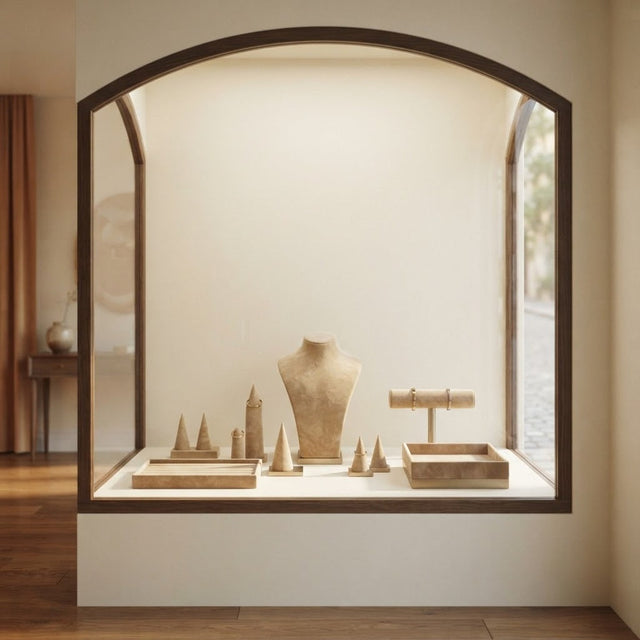
Follow the logic of the three heights mentioned above: a tall bust at the back, a flat stand at an intermediate height, and a low flat stand at the front. The eye moves from one level to the next without ever hitting an obstacle.
Lighting without glare
A warm spotlight placed slightly above and to the side gives definition to the way the necklace falls and avoids direct reflections on the velvet or acrylic.
How many busts and stands to plan for a necklace display?
There is no magic number, but a few practical guidelines help to arrange without overcrowding. One focal point, a few secondary stands, and space around them: that is the recipe for a clear display.
One focal point per display
Choose a bust or a featured stand for the piece you want to highlight. It catches the eye first, while the other stands complement it without competing with it.
Playing with odd numbers
Three stands of different heights form a more natural group than two or four. This is the logic of the "three heights": a tall bust, an intermediate stand, and a low stand.
Leaving space between pieces
A necklace needs space around it to be seen. Leave clear space between two stands: the eye can move freely and each piece stands out.
Rotating pieces regularly
Rather than adding more stands, change the necklaces on display. A display renewed every two or three weeks makes people want to come back and look.
What mistakes to avoid with a bust or flat stand?
A few simple habits help avoid failed displays. Here are the four most common mistakes and how to correct them.
A bust too small for the necklace
This is mistake number one: a long necklace on a short bust will wrap around and get lost. Refer to the necklace type chart to choose the right height.
Too many pieces of jewelry on a single stand
An overcrowded bust is no longer clear: each necklace must stand out from the others. Beyond three necklaces on the same bust, it is better to add a second stand.
Clashing stand styles
A black velvet bust next to a raw wood tray, a gold frame, and an acrylic plate creates a confusing display. Stick to the same family of colors and materials.
A background that swallows the jewelry
A gold chain on a gold background, a white pearl on a white background: the jewelry disappears. Always choose a background that contrasts with the metal.
How to maintain and store your busts and flat stands?
A clean stand is noticeable, and so is a dusty one. Regular maintenance preserves the material and color, and maintains the professional appearance of the display.
Dusting every week
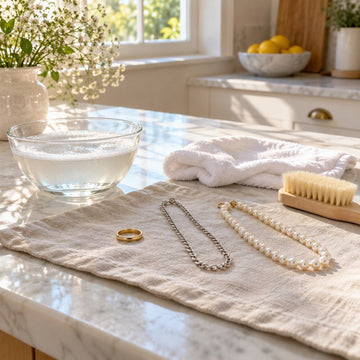
Run a soft brush or a dry microfiber cloth over the velvet and faux leather, always in the same direction. For wood, marble, and acrylic, a barely damp soft cloth is enough, followed by drying with a dry cloth.
Protecting from light and moisture
Direct sunlight fades fabrics, and heat warps certain materials. Also avoid damp areas: moisture stains velvet and tarnishes metal.
Storing between displays
Store busts upright or lying on a clean fabric, without stacking heavy objects on top. Slide flat stands into a cover or box, separated by a sheet of tissue paper to prevent rubbing.
Checking before putting them back on display
Check for stains, pulled threads, and chipped edges before putting a stand back in the display case. A damaged detail is more noticeable than you might think.

Our favorites: busts and stands to discover
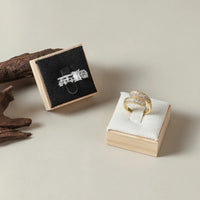
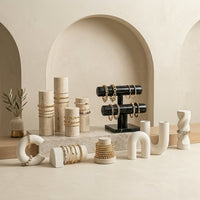
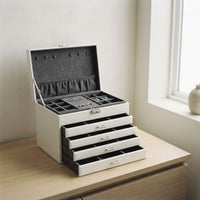
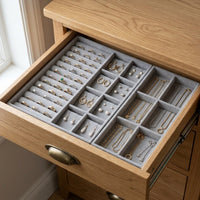
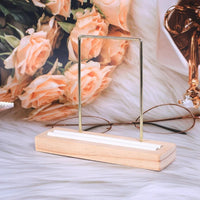
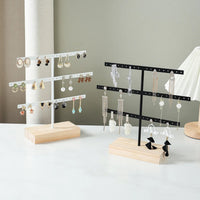
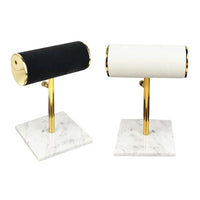
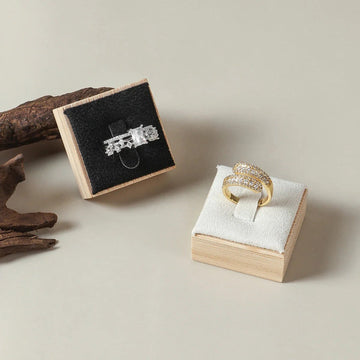
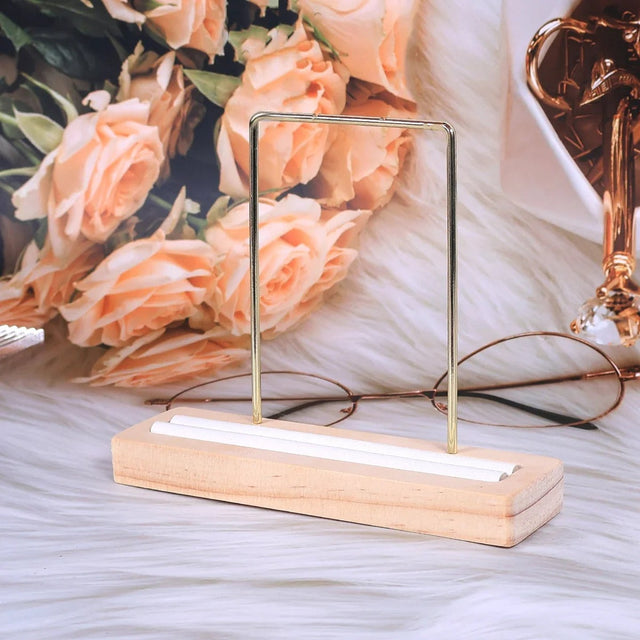
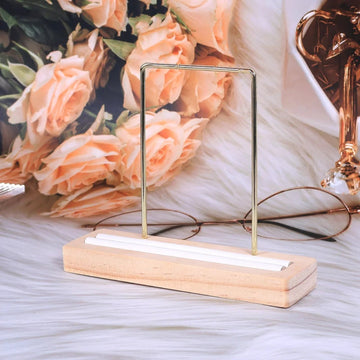
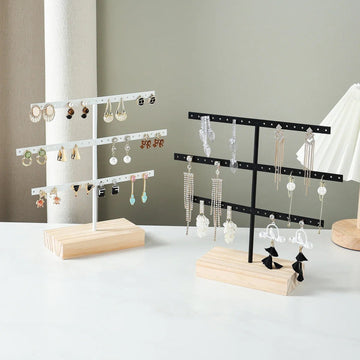
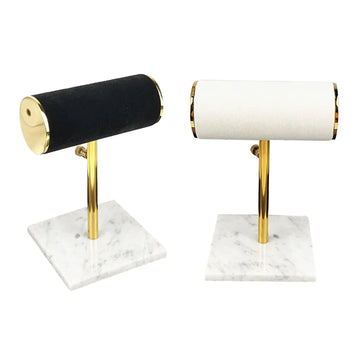
These four models illustrate the families seen in the article: the black velvet bust for a classic display, the series of beige busts for playing with heights, the wooden and velvet flat stands for a graphic display, and the small busts on stands to complete a composition.


To browse the full range, visit the jewelry busts collection, necklace and chain displays, or jewelry trays for flat stands.
Conclusion: complementarity rather than opposition
The bust remains irreplaceable for showing how a piece looks when worn. The flat stand reveals the design of the jewelry and makes flatlay photos easier. The best strategy is to combine the two according to your catalog.

To go further: What size display to choose according to the type of jewelry?, Individual or multi-jewelry display: which one to choose for a display case?, What is the best display for rings if you have little space? and How to properly display your necklaces: busts, mannequins, and stands.
FAQ: bust display or flat stand?
Which format sells best in stores?
The bust remains slightly more effective in physical stores because it triggers the mental projection of wearing the piece.
Can you layer several necklaces on the same bust?
Yes, up to three necklaces of different lengths. Choose a tall bust (at least 45 cm).
Is a flat stand suitable for a long necklace?
Yes, provided you have a large surface (at least 35 x 25 cm).
What material to choose for a professional necklace bust?
Matte velvet remains the standard. Smooth faux leather for a contemporary look.
How to prevent a necklace from slipping on a flat stand?
Choose a slightly textured stand (velvet, linen, microfiber).
Should you plan several bust heights in the same display case?
Yes. Ideally, combine a short bust, a medium bust, and a tall bust.
Is a flat stand suitable for a premium display case?
Absolutely, provided you choose fine materials (marble, precious wood, matte metal).
Get our next articles
Tips, guides and new arrivals, straight to your inbox.