
























How to choose a professional jewelry display?
Why choose your professional jewelry display carefully
Choosing a professional jewelry display is never a minor detail. It is the support that determines whether a ring catches the eye, whether a necklace looks rare, whether a customer hesitates or buys. All too often, designers, boutiques, and jewelers invest in magnificent pieces… then display them on unsuitable supports that flatten their perceived value.
The result: declining sales, flat display cases, dull product photos. This guide explains step by step how to select a truly professional display: which materials to favor, which format to choose according to your type of jewelry, how to harmonize your display case, and which criteria really make the difference in stores and at markets.

Why a professional display makes all the difference
A piece of jewelry only truly exists from the moment it is showcased. On a bare counter, even the most beautiful ring disappears. Placed on a black velvet stand with clean curves, it becomes desirable.
The role of a professional jewelry display is not decorative: it guides the eye, suggests a price, tells a brand story, and makes it easier for the customer to handle.
Visual merchandising studies are unanimous: a product presented at eye level, isolated on a contrasting support, sees its conversion rate rise significantly. This applies to an individual display highlighted in a display case as well as to a collective tray placed on a market stand.
Consumer display vs. professional display: the real difference
A consumer display is generally designed for storage: it accumulates items without hierarchy. A professional display, on the other hand, is designed to sell. It respects precise standards: meticulous finishes, calibrated dimensions, high-quality or technical materials, a stable base, and the possibility of being combined with other modules.

The 7 key criteria to check before buying

Before clicking "buy", compare your needs with this checklist.
- Stability: a wobbly display immediately betrays a product. The base must be weighted or wide enough not to tip over even when loaded.
- Quality of finishes: even velvet seams, varnish on wood without drips, perfectly polished acrylic edges.
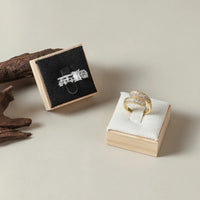
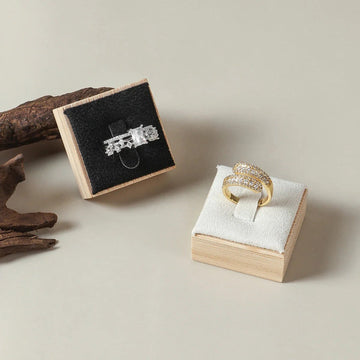
- Contrast with the jewelry: silver appears sharper on a dark background, yellow gold shines on off-white or pearl gray.
- Dimensions: a display that is too large "crushes" a delicate piece of jewelry, while one that is too small makes it look bulky.
- Ergonomics of handling: the customer must be able to pick up and put down the jewelry without fear of dropping everything.
- Modularity: being able to create several heights and formats gives rhythm to the display case.
- Durability: a professional display is used for several years. Low-end models tarnish in a few months.
If your future purchase checks at least 6 of these 7 criteria, you are looking at a professional product.
Which materials to choose: velvet, wood, acrylic, metal?

The material of a display is never neutral. It conveys a universe, justifies a price range, and guides the perception of the jewelry.
| Material | Universe conveyed | Ideal for | Points of attention |
|---|---|---|---|
| Velvet | Luxury, jewel box, timeless | Fine rings, wedding bands, precious stones | Choose a quality matte velvet |
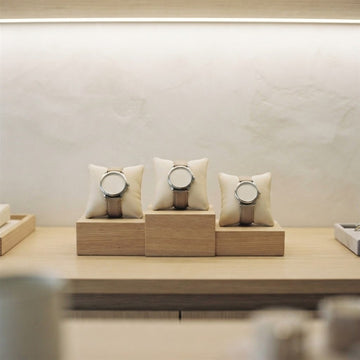
| Light wood (oak, beech, bamboo) | Natural, artisanal, Scandinavian | Designers, handmade jewelry | Check the finish for fine chains |
| Transparent acrylic | Modern, minimalist, contemporary | Design boutiques, colorful jewelry | Sensitive to scratches |
| Metal (brass, gold, matte black) | Premium, architectural | High-end display cases | Heavier, requires precise lighting |
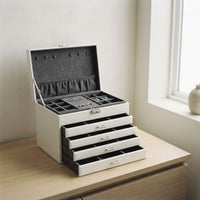
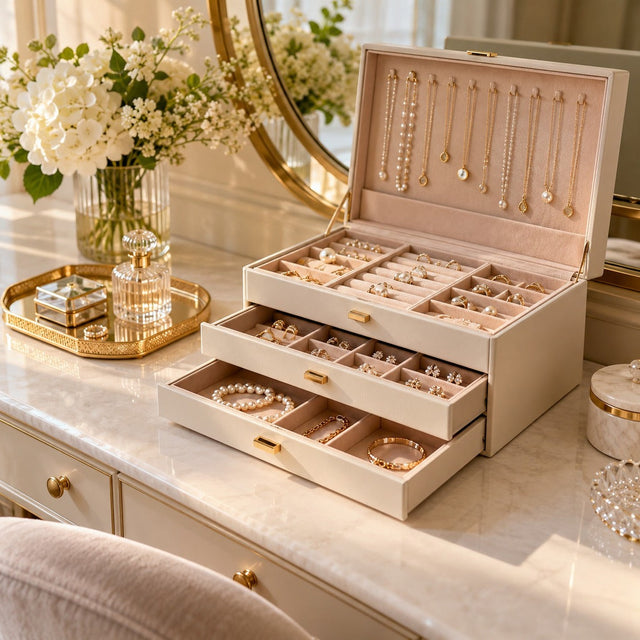
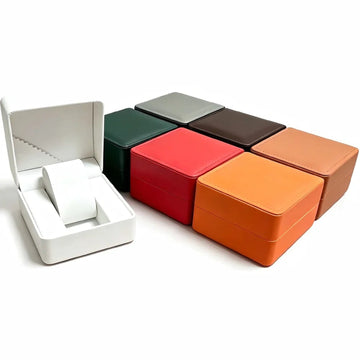
| Leather / faux leather | Timeless, classic jewelry | Display trays, jewel boxes | Favor fine stitching and deep colors |
Many boutiques mix two materials to create a coherent universe: a light wood background with velvet inserts works particularly well for contemporary jewelry.

Which format for each type of jewelry?
Each jewelry family calls for a specific type of support. Choosing a universal jewelry store stand is a false good idea.
For rings
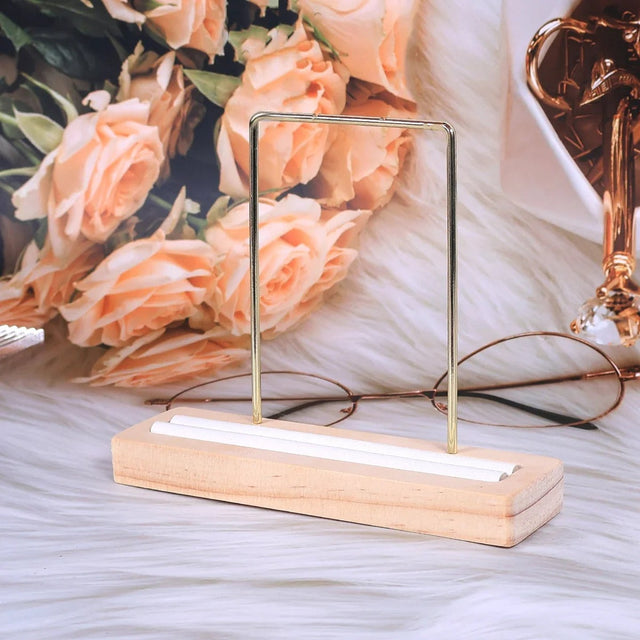
The most effective ring displays are those that present the rings at height, slightly tilted toward the customer. "Bar" models aligning 6 to 12 rings are perfect for capsule collections.
For necklaces
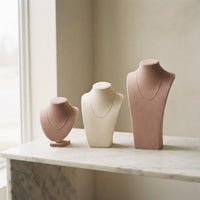
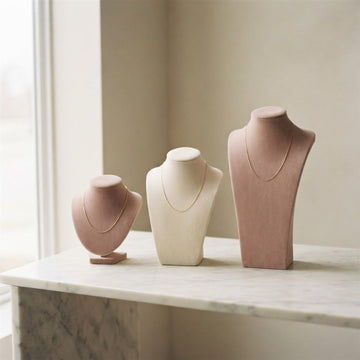
The bust remains the absolute reference: it restores the drape of the jewelry, its length, and the way it is worn. T or L shaped supports are a more airy alternative for minimalist display cases.
For bracelets and bangles
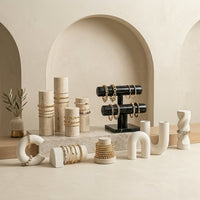
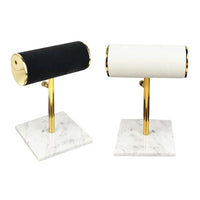
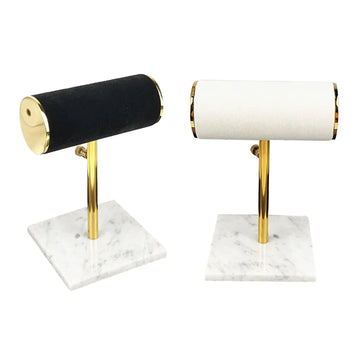
Cylindrical or half-moon displays allow the natural curvature of the jewelry to be respected. Horizontal bar models are perfect for aligning several matching bangles.
For earrings
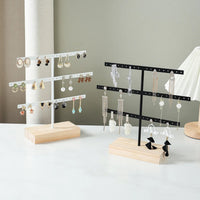
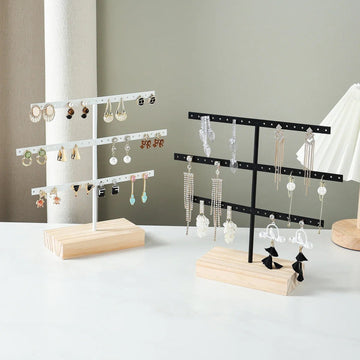
Perforated hook displays or velvet plaques are the most versatile. For statement pieces, an individual triangular or stylized ear support enhances the perceived value.
Find the display suited to each type of jewelry
Our catalog covers all families: rings, necklaces, bracelets, earrings.
See the full collection of displaysHarmonizing your display case: colors, heights, staging

An isolated display is not enough: it is the whole that creates the "professional" effect. Three fundamental principles structure any successful staging.
1. The rule of three heights
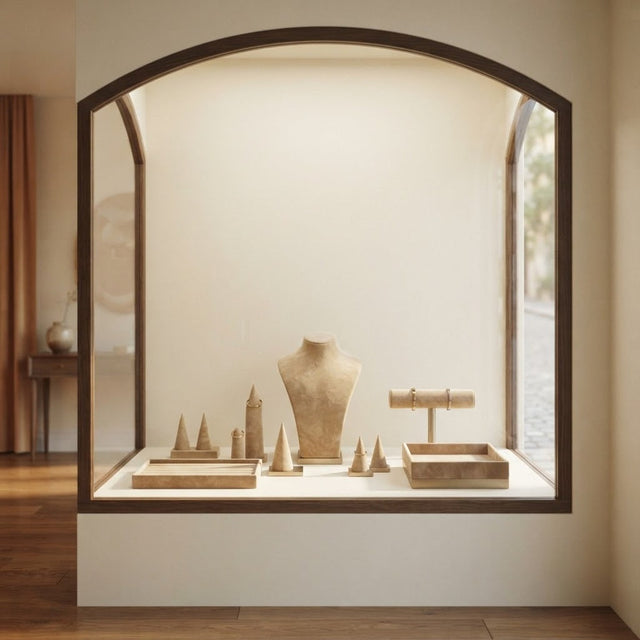
Systematically combine three levels: a low point (tray), an intermediate point (simple display), and a high point (bust, tower, vertical support). The eye naturally follows this diagonal.
2. A restricted palette
Limit yourself to two main colors for your supports, with an accent color if desired. A pearl gray background, black velvet, and a touch of brass are enough to build a professional display case.
3. Empty space, your best ally
An overloaded display case lowers the perceived value. Leaving space between the displays enhances each piece. Allow about 30 to 50% of the surface to be left free.

The most common mistakes to avoid
- Mixing too many materials: a maximum of three different families, otherwise your display case becomes unreadable.
- Choosing displays with colors too close to the jewelry: a gold bracelet on a gold support disappears visually.
- Ignoring the lighting: even the most beautiful display is useless without suitable light.
- Buying an uncoordinated set: prefer a coherent range from the same supplier.
- Underestimating ergonomics: a display that is difficult to handle slows down the sale.
What budget to set aside for professional equipment?

The budget depends on your sales format. Here are realistic ranges:
- Market / pop-up launch: €80 to €200 for a complete set (trays, busts, ring and earring displays).
- Small permanent boutique display case: €250 to €600 for quality modular equipment.
- Professional jewelry store: €600 to €1,500 with high-end displays.
- Jewelry photo studio: plan for a dedicated set with neutral supports for shoots.
Consider these amounts as an investment amortized over several years. A good display, maintained, easily lasts 5 to 10 years.
Build your professional display case in a few clicks
From the jewel box to the premium necklace bust, create a coherent universe thanks to our selection designed for pros.
Discover our jewelry traysLighting a professional jewelry display: lighting does half the work
The most beautiful support loses its effect under poorly chosen light. Lighting makes the facets shine, reveals the materials, and guides the eye to the right piece.
A neutral and directed light
Favor a neutral white, neither too yellow nor too cold, so as not to distort gold or silver. Direct the beam diagonally, slightly above the jewelry: it highlights the reliefs without flattening them.
Avoiding reflections and cast shadows
Acrylic and glass reflect light: a spotlight placed from the front creates an annoying reflection. Velvet, on the other hand, absorbs light and requires slightly more generous lighting so as not to appear dull.
Test before opening
Place yourself at the customer's eye level and go around the display case. Also check the rendering at several hours of the day, because daylight changes the effect of the spotlights.

Adapting Your Professional Jewelry Display to Your Point of Sale
The same display will serve different purposes in a store, at a market, or in front of a camera. First, consider the location.
| Point of Sale | Priority | Recommended Materials |
|---|---|---|
| Brick-and-mortar Store | Consistency and Durability | Velvet, Wood, Metal |
| Market or Trade Show | Lightweight and Stability | Light Wood, Easy-to-Nest Pieces |
| Online Product Photography | Neutrality | Dark Velvet, Clear Acrylic |
In a Brick-and-Mortar Store
Stability and longevity are paramount. You can create varied heights and leave the supports in place for several seasons.
At a Market or Trade Show
Everything must be quick to assemble and easy to transport without damage. Choose sturdy, easy-to-nest pieces and use covers for transport.
For Online Product Photography
Neutral, solid-colored supports prevent distractions. Use the same background for every photo to create a consistent online store.
Building Your First Range of Displays Step by Step
Starting without a plan often leads to scattered purchases of pieces that do not match. A four-step method helps you avoid duplicates and maintain a consistent display from the start.
- List your jewelry by category: rings, necklaces, bracelets, earrings.
- Choose one dominant material and a single accent color.
- Plan three heights: a tray, an intermediate support, and a bust or tower.
- Order one piece for each category, test it, then complete the set.
Start Small, Then Complete the Set
A smaller initial set allows you to assess the actual effect in a display case or on a stand. Then, add pieces from the same range to ensure the materials and colors remain harmonious.
Leave Room for Featured Pieces
Reserve one or two individual supports for your statement pieces. Displayed alone on a dedicated stand, they draw the eye and set the tone for the entire display.

Maintaining and Updating Your Display Equipment
Professional equipment will last for years if properly maintained. A few regular steps are all it takes to keep a display case looking impeccable.
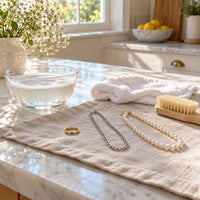
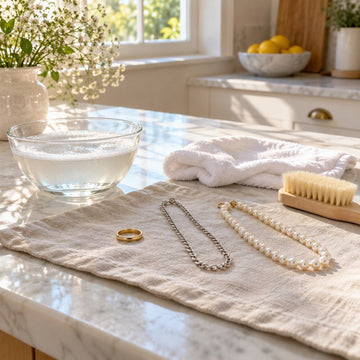
Clean According to the Material
- Velvet: Brush gently in the direction of the nap.
- Wood: Use a barely damp soft cloth.
- Acrylic: Use a microfiber cloth without alcohol.
- Metal: Use a dry cloth to prevent smudges.
Store Between Events
Store each piece away from dust and moisture, in a cover or padded box, with a cloth between each item.
Knowing When to Replace
Marked velvet, scratched acrylic, or chipped wood send the wrong message to customers. Replace the most visible pieces first and keep the less damaged ones for the background.

Our Favorites for Equipping a Professional Display Case
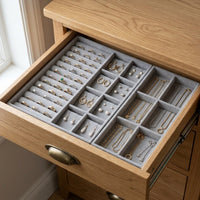
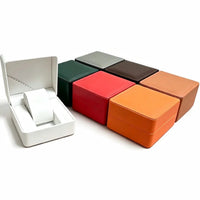
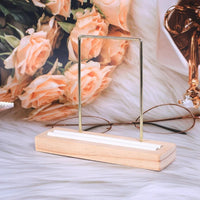
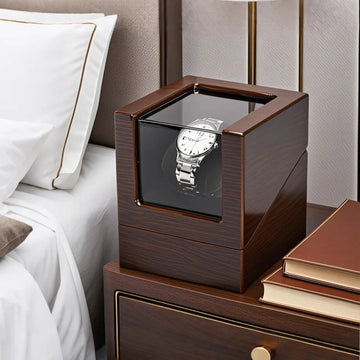
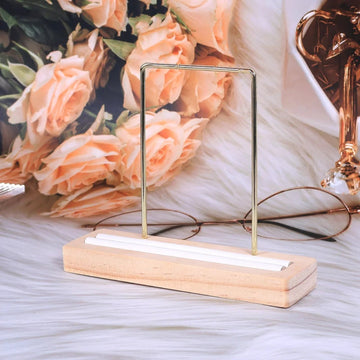
Four selections show how to combine contrast, stability, and consistency: a bust, trays, and a matching set.


To continue, explore the velvet jewelry display and jewelry case collections. To prepare for an event, also read how to set up a professional jewelry stand and how to create an elegant display case.
Conclusion: An Investment That Quickly Pays Off
Choosing a professional jewelry display is a strategic decision for your brand. Good supports are barely noticeable: they highlight your creations without ever stealing the spotlight. By applying the seven key criteria and following the principles of display, you will transform your display case into a powerful sales tool.

FAQ: Your Questions About Choosing a Display
What is the best material for a professional jewelry display?
There is no single best material: it all depends on your brand identity. Velvet remains the standard for classic fine jewelry, light wood suits artisanal creators, acrylic is ideal for modern concept stores, and metal is best for premium brands.
How many displays do you need to start a market stand?
Plan for at least 4 to 6 different supports: a necklace bust, a ring tray, an earring display, a bracelet display, and ideally one or two individual supports for statement pieces.
How do you maintain a velvet display?
Brush regularly with a soft brush in the direction of the nap. In case of a stain, blot without rubbing with a slightly damp cloth. Avoid direct exposure to sunlight.
Should all your displays be the same color?
Not necessarily, but stick to a limited palette of two main colors and one accent color.
What is the ideal height for a display case?
The focal point of a display case is between 1.30 m and 1.60 m from the floor on the customer's side, at eye level.
Black velvet or gray velvet display: which should you choose?
Black is more dramatic and highlights silver and white gold. Gray is more versatile and works with all metals.
Can you use the same displays in a store and for product photography?
Yes, provided they are neutral and solid-colored. Dark velvet or clear acrylic work particularly well for both uses.
Should you buy displays individually or in sets?
Sets are more economical and ensure visual consistency. But first, identify your exact needs by jewelry type before ordering.
How can you test a display before ordering several?
Start with one piece from each category, place your actual jewelry on it, and view the result at eye level under your lighting. If you are convinced by the effect, order the set.
What display color makes gold stand out?
Yellow gold stands out against off-white or pearl gray, as mentioned above, while silver appears sharper against a dark background. Avoid a support in the same shade as the jewelry.
How do you light a jewelry display case without reflections?
Angle the spotlights rather than pointing them directly at the display, especially with acrylic or glass, and prefer a neutral white. Check the result from the customer's side.
How do you store your displays between trade shows?
Clean them, then store them in covers or padded boxes, with a cloth between each item, in a dry place.
Should a professional display be modular?
It is not mandatory, but it is a real asset: by combining several heights and formats, you can refresh the display without buying new supports.
Get our next articles
Tips, guides and new arrivals, straight to your inbox.